


Published in:

Germany’s biggest nature travel magazine
8 pages | text & photography
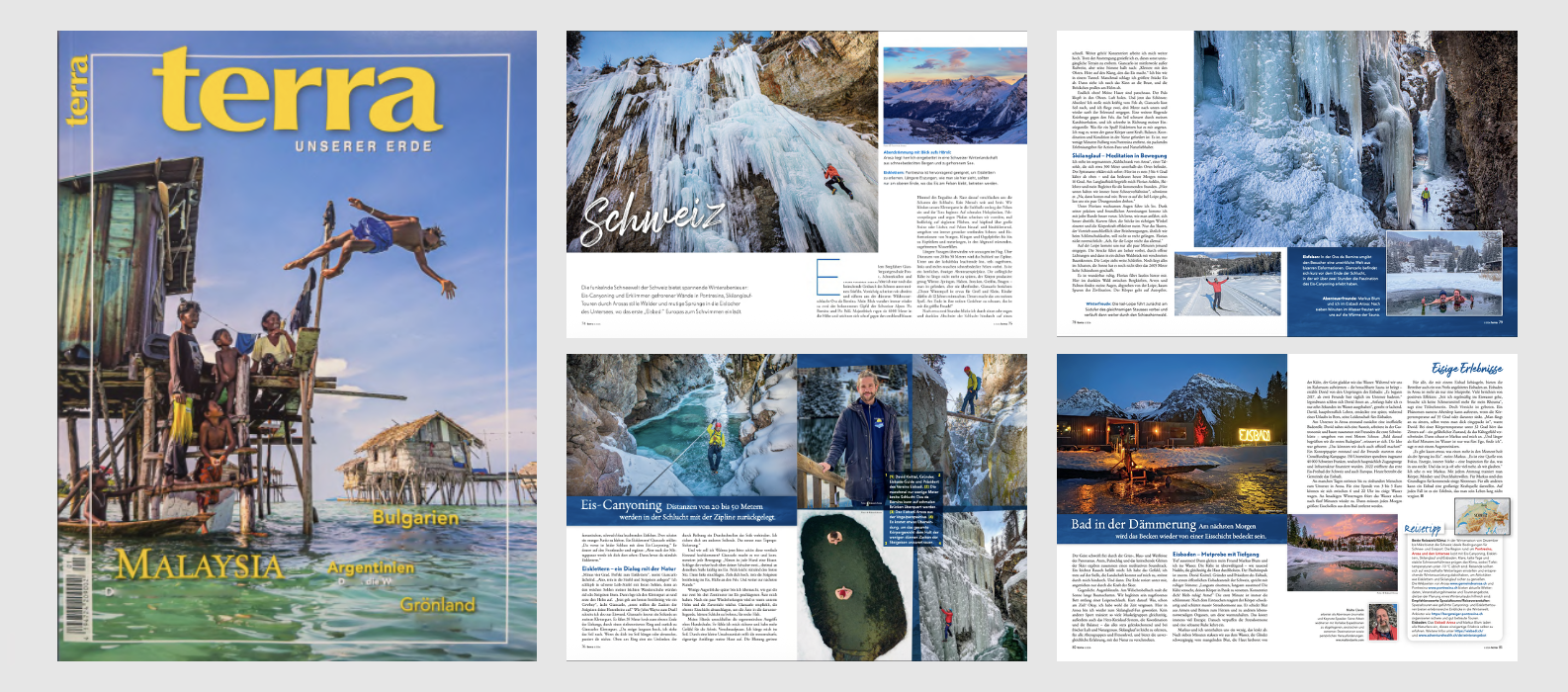
Winter canyoning – a dance through Pontresina’s frozen gorges
Just a few minutes after mountain guide Giancarlo Salis and I leave the Pontresina mountaineering school wearing climbing harnesses, snow claws and helmets, all I can hear is the crunching sound of snow under my boots.
We walk carefully downhill and approach the gloomy Ova da Bernina gorge. My gaze lingers on two of the most famous peaks in the Swiss Alps: Piz Bernina and Piz Palü. They rise majestically 4,000 metres into the air and stand out sharply against the bright blue sky of the Engadin. A minute later, the shadows of the gorge swallow us up. There is no one here but us.
Metre-long frozen waterfalls plunging into the abyss
We clip our climbing harnesses into the steel ropes along the rocks and the dance begins: we make our way along narrow wooden planks, rocky ledges and narrow paths, sometimes carefully on ice-slick surfaces, sometimes hopping over large stones or holes, sometimes climbing up and down rocks, surrounded by increasingly grotesque snow and ice formations: From poles, blades and organ pipes to ice pillars and metre-long frozen waterfalls plunging into the abyss.
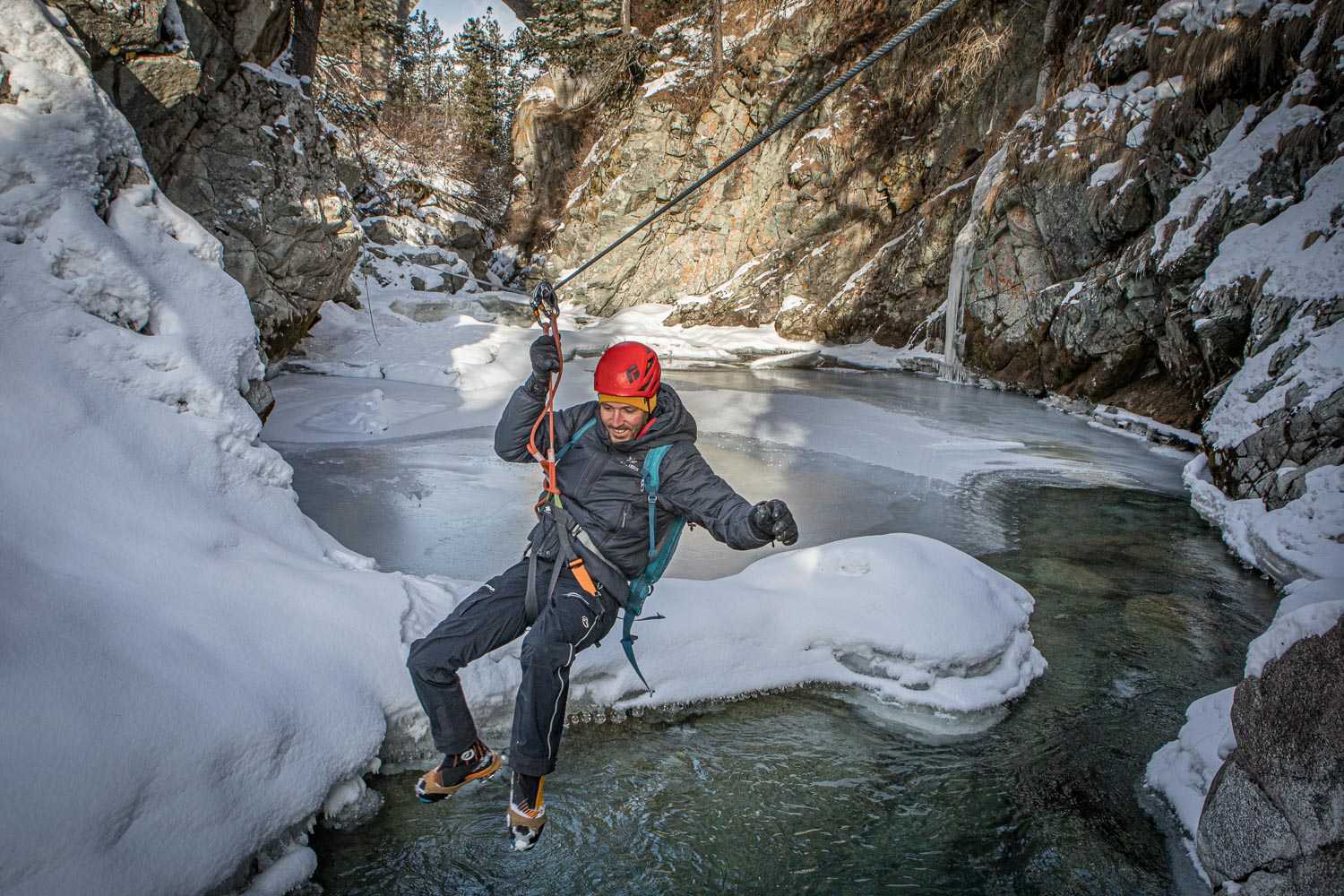
Giancarlo bridges a long section of the Ova da Bernina gorge with the zipline.
We overcome longer passages in flight. Over distances of 20 to 50 metres, the steel cable becomes a zipline. Below us is the dark cobalt-blue Inn, partly frozen over, with snow-covered rocks and icy beauties rushing past to the left and right.
“The body is challenged, but never overtaxed.”
It is a marvellous, frosty adventure playground. The initial cold has long gone, the body is producing enough warmth. Jumping, holding, stretching, gripping, bending – the body is challenged, but never overtaxed. Giancarlo adds: “This winter fun is something for young and old. Children can take part from the age of 12. They have the most fun. Looking at their proud faces at the end is my greatest pleasure!”
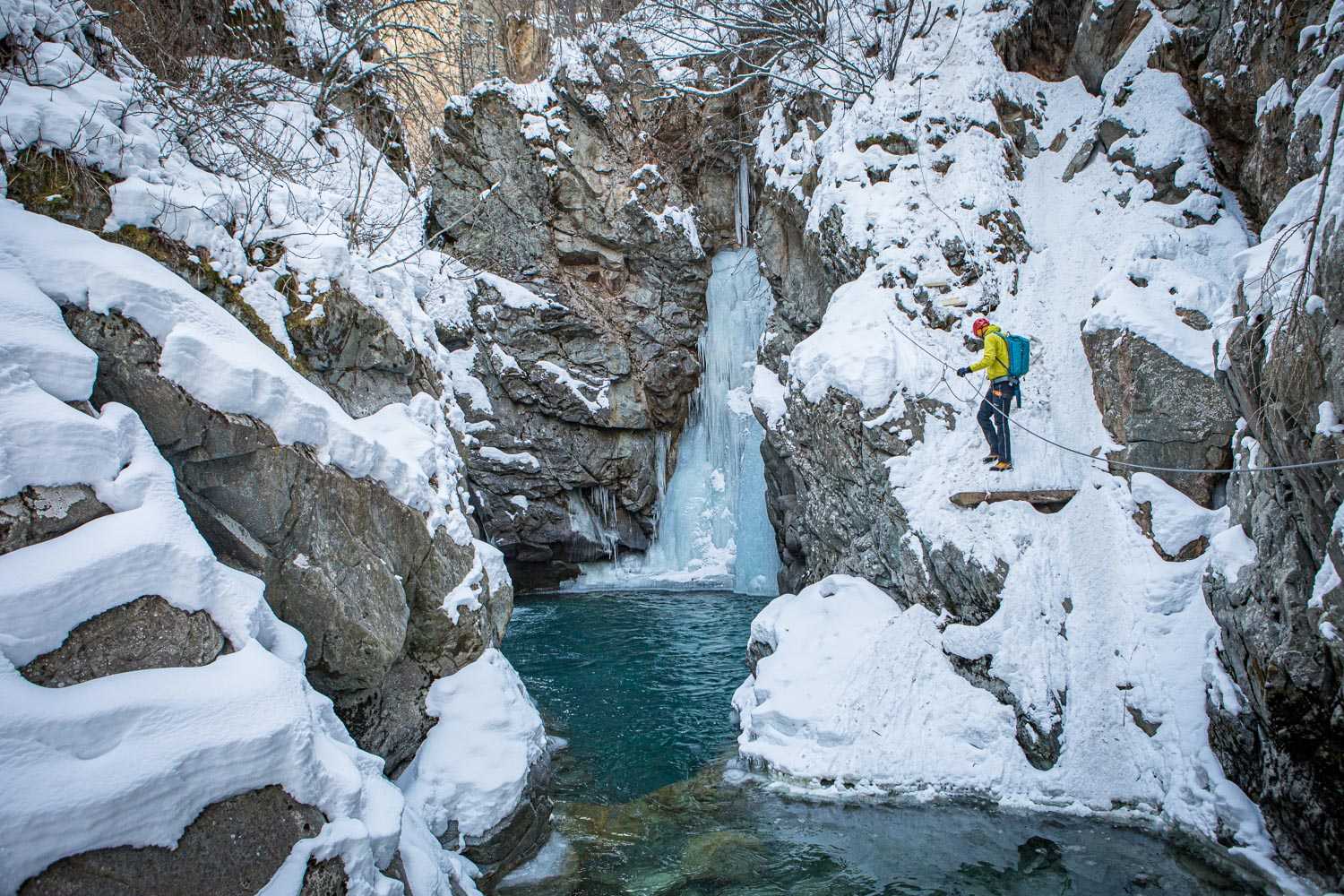
The ice canyoning route takes Giancarlo and me past a frozen waterfall.
After about two hours, I look through a very narrow and dark section of the gorge at a fantastically bizarre, faintly blue glowing ice cliff. An orange dot seems to be stuck there. An ice climber!
“Unfortunately, that’s where the ice canyoning ends.”
Giancarlo adds: “Unfortunately, that’s where the ice canyoning ends.” He points to the ice climber and says: “But I’ll see you there after the lunch break: That’s when you’ll learn how to ice climb.”
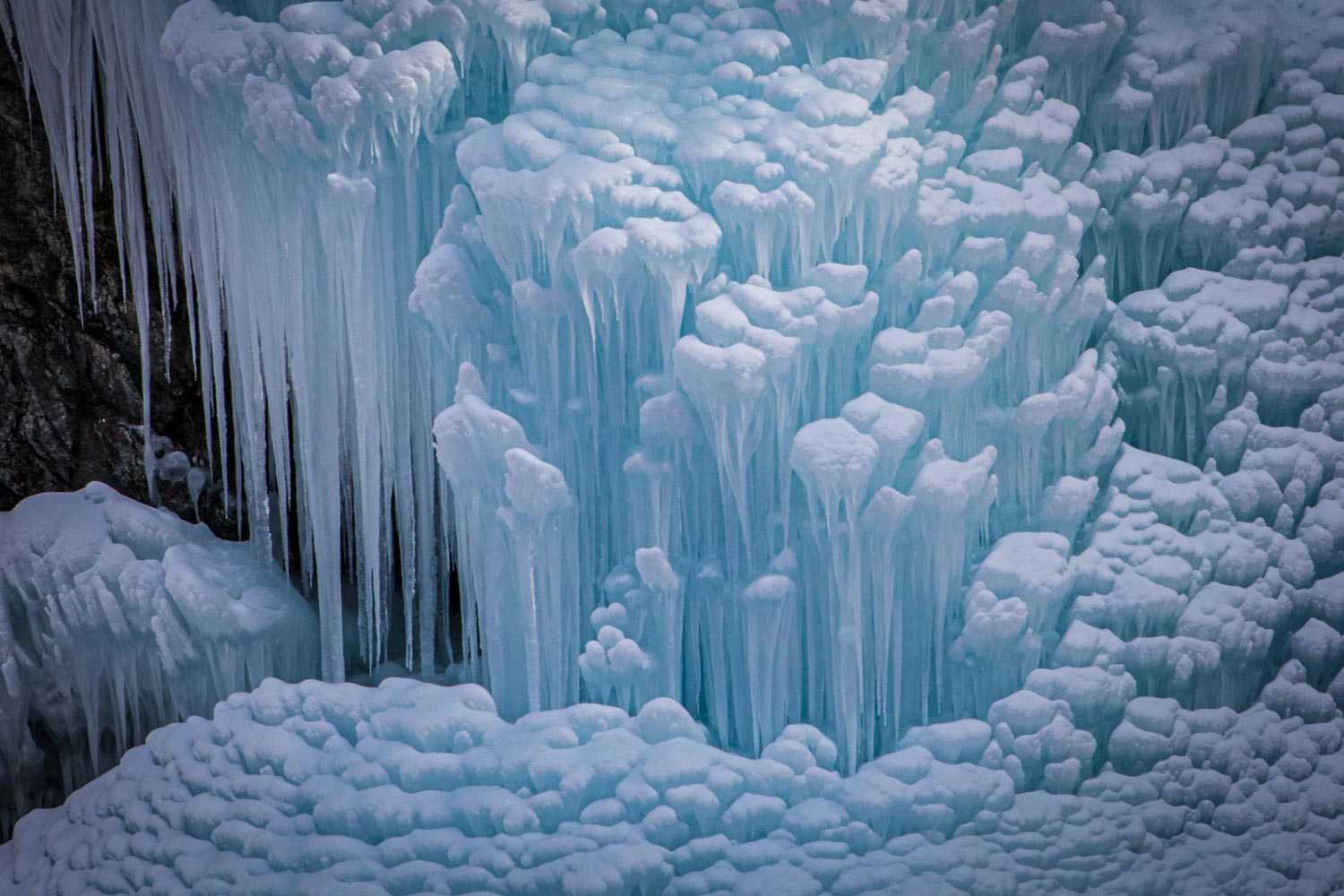
Large parts of the gorge’s rock faces are overgrown with icy beauties.
After a brief high of excitement, quickly cooled down and hungry, I find myself in Pontresina’s Via Maistra at the Gianottis restaurant. There, my clammy fingers clasp a warmed-up glass, ready for the “Café Schümli Pflümli” – a Swiss classic with plum brandy, whipped cream and a pinch of cocoa. The main course, a hearty venison tartare, provides me with the energy I need for the sporty afternoon ahead.
“Minus four degrees. Perfect for ice climbing”
Ice climbing – a dialogue with natur
“Minus four degrees. Perfect for ice climbing,” says Giancarlo with a smile. “So, get into your boots and put on your crampons,” he orders. I slip into heavy rental boots with sturdy soles, because the crampons would come loose on the soft soles of my light hiking boots.
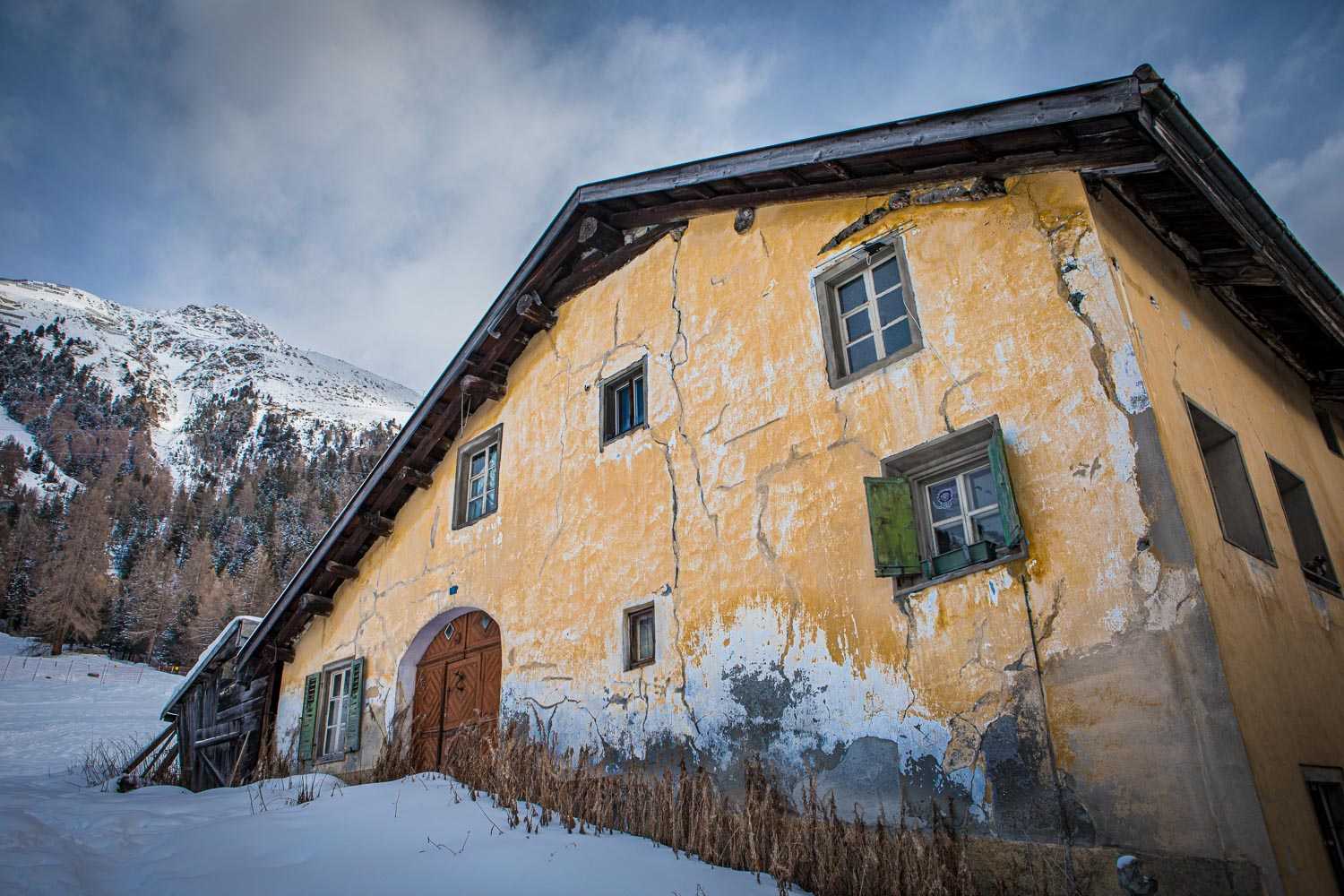
Weathered and charming: a house in Pontresina, surrounded by snow-capped mountains and wintry silence.
Then I put on my climbing harness and helmet. “Now it’s Western time,” laughs Giancarlo, “it’s best to walk with your legs apart, otherwise the prongs of the crampons will tear your trouser legs.” Like John Wayne in a duel, I stride towards the ice wall until I’m standing right in front of it.
And how am I supposed to get the walrus up this vertical wall of ice?
Giancarlo ties the end of a rope to my climbing harness. It leads 35 metres up to the top of the ice slope, through a ring set in concrete and back to Giancarlo’s climbing harness. “You climb up slowly, I’ll pull the rope up. If you get caught in the rope or slip, nothing will happen to you. At the top of the ring, there’s a guide that prevents the rope from slipping through due to friction. I belay you at the other end of the rope. This is called toprope belaying.” And how am I supposed to get the walrus up this vertical wall of ice?
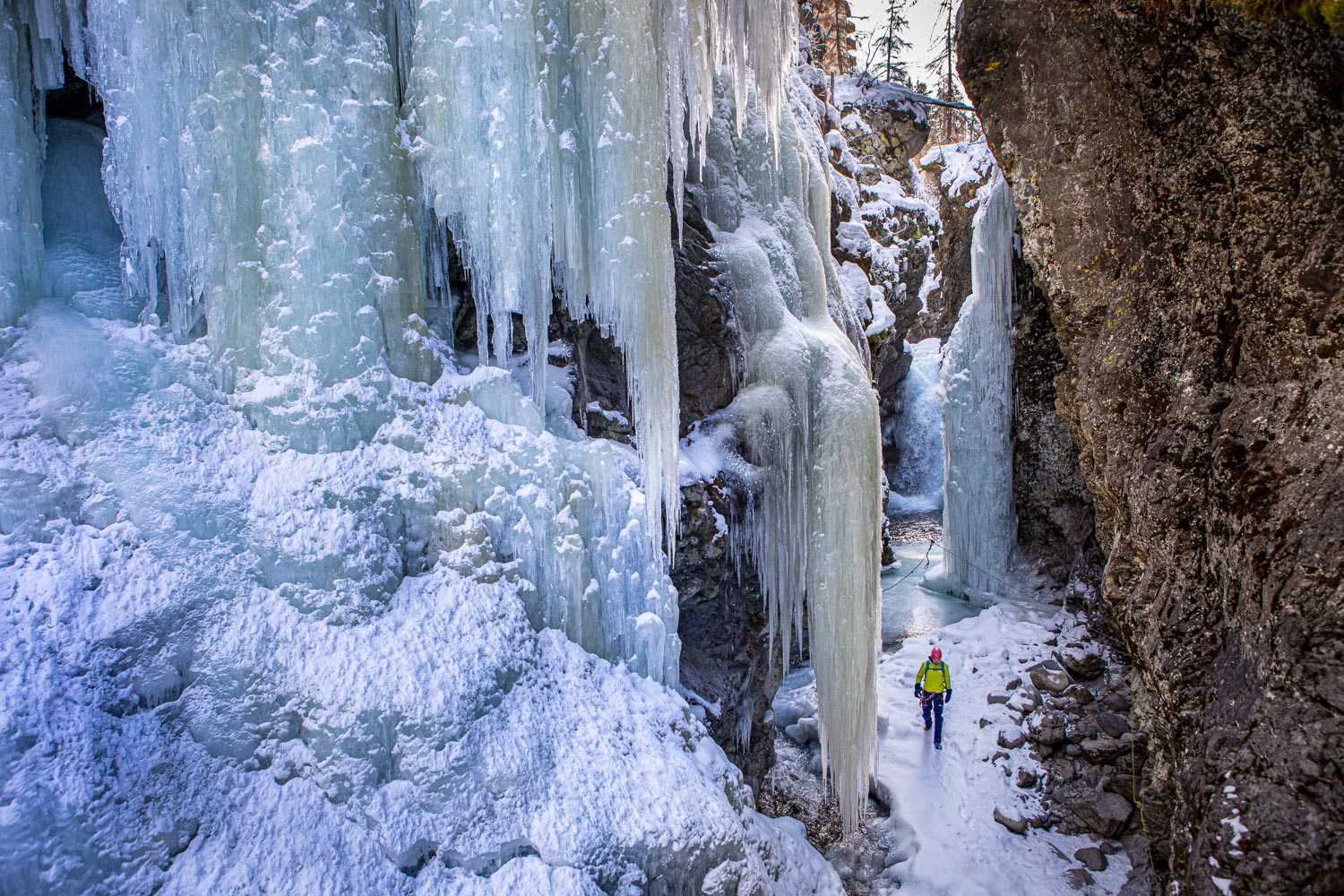
Giancarlo is just before the end of the gorge, where we experienced the fascination of ice canyoning for over two hours.
Giancarlo demonstrates and comments on every movement: “Take an ice axe in each hand. Strike the right one high above your shoulder two or three times hard into the ice in the same place. Shake lightly to check that it is firmly seated. Then strike the left one. Pull yourself up, kick the crampons wide-legged into the ice, hips against the rock. And on to the next round.”
“Push your butt against the wall!“
A few moments later, I am surprised at how well the axes, which are only two to three centimetres deep in the ice, hold me. After a few repetitions, it gets warm under my helmet. Giancarlo shouts from below: “Keep your feet level, bum against the wall!” Experience and confidence grow with the repetitions. Giancarlo recommends chipping off the top layer of ice to drill the axes into the harder layer below for more grip.
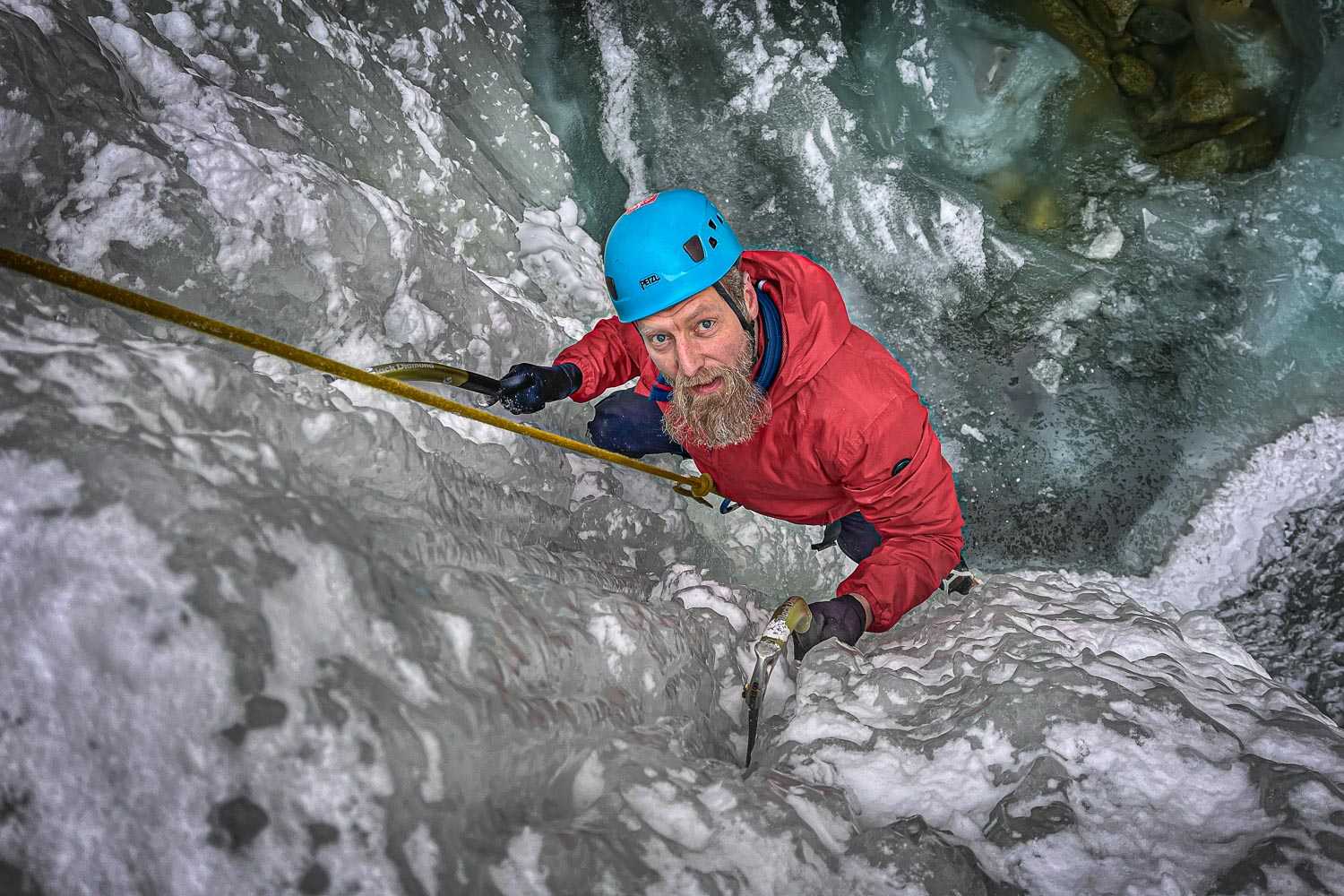
My first steps in ice climbing: I was immediately hooked. It fascinates me when nature challenges my entire physical strength, balance, coordination and endurance.
My hands grip the ergonomic axe handles without gloves. I feel safer and have more feeling for the work. A breather. I hang onto the rope. A little carelessness causes the razor-sharp, saw-like axe blade to tear open my skin. The haemorrhage coagulates quickly. On we go.
I’m feeling like I’m in a tunnel
I continue to work my way up, panting with concentration. Despite the effort, I enjoy conquering this otherwise inaccessible terrain. Giancarlo is now out of range, but his voice echoes: “Climb with your ears. Listen to the sound the ice makes.” I feel like I’m in a tunnel. Sometimes I break off large pieces of ice. Then I quickly pull my chin to my chest and the chunks bounce off my helmet.
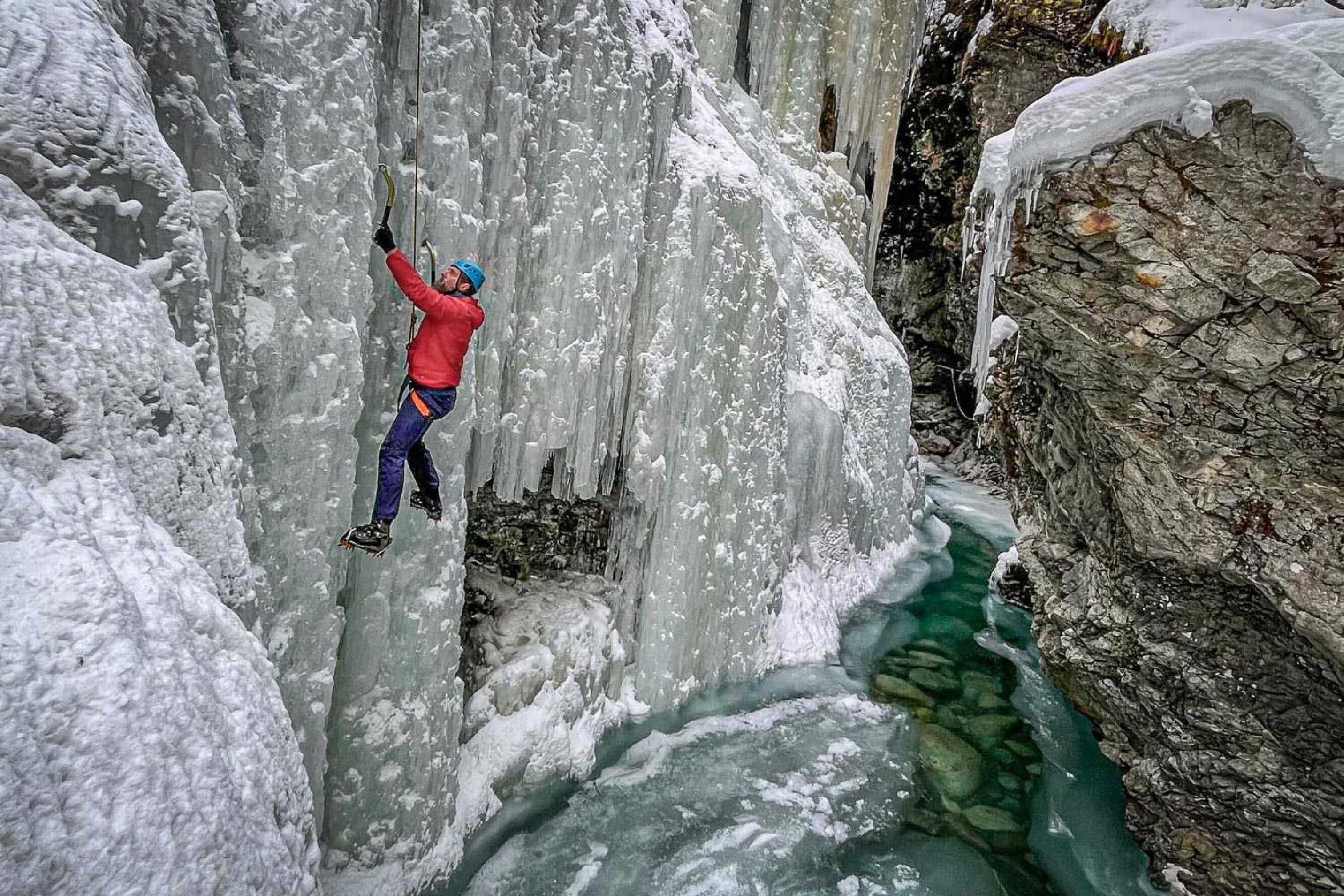
My first steps in ice climbing: I was immediately hooked. It fascinates me when nature challenges my entire physical strength, balance, coordination and endurance.
Up at last! My hair is soaking wet. My pulse is pounding in my ears. Catch my breath. And now the best part: Abseiling! I push myself hard off the rock, Giancarlo eases the rope down and I fly two or three metres down and gently back towards the rock face. Another flying knee bend against the rock, the rope purrs through my carabiner and I float on towards my access point. What fun!
A thrilling experience for action fans
I’m really into ice climbing. I like it when the whole body is challenged, including strength, balance, coordination and fitness. In the great outdoors. With marvellous views of snow formations and ice creations. I feel like I’ve expanded my vocabulary for travelling on ice and vertically. And just a few minutes’ walk from Pontresina, this is a thrilling experience for action fans and nature lovers.
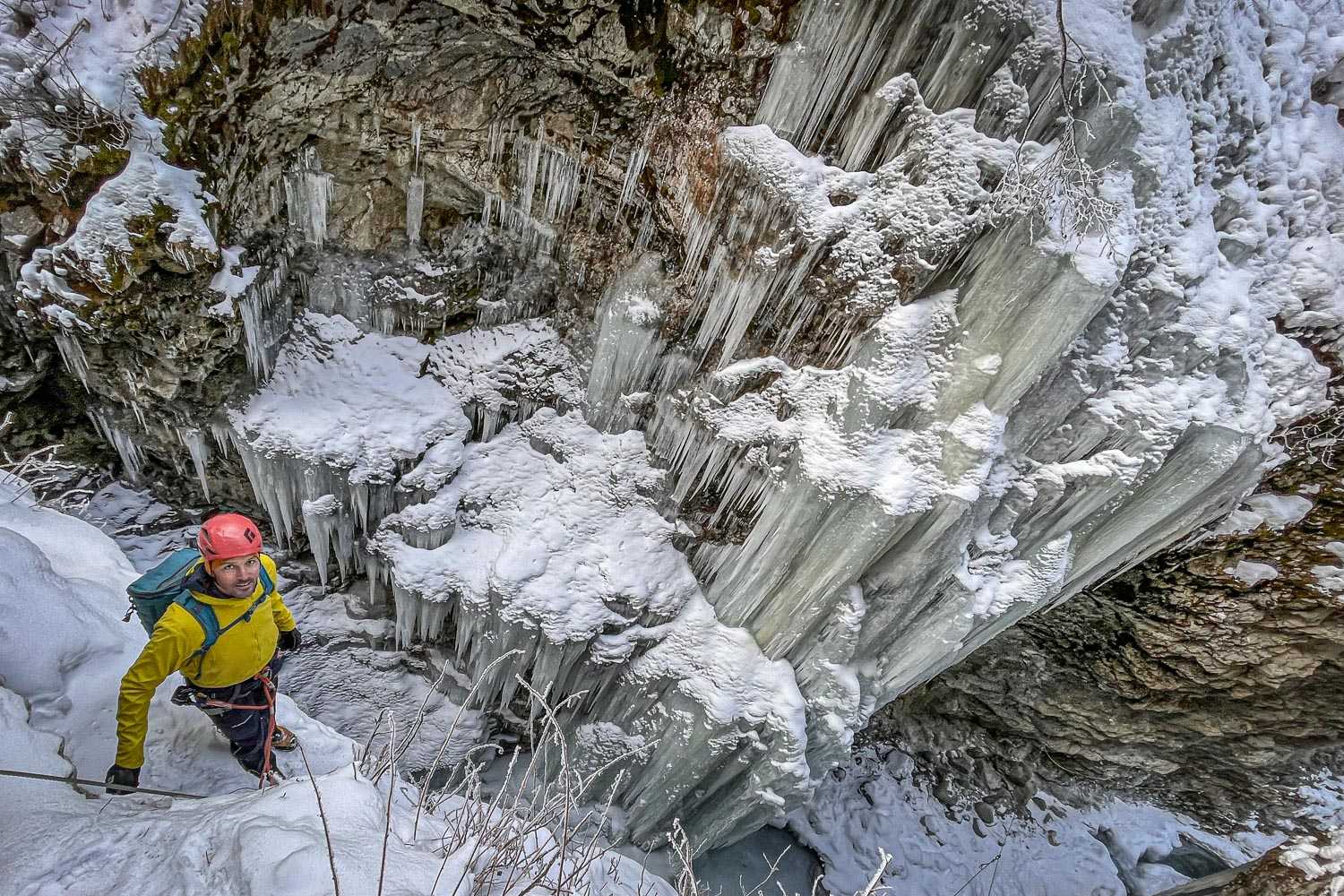
We make our way along narrow paths, surrounded by increasingly grotesque snow and ice formations.
Cross-country skiing – meditation in motion
I’m standing in the so-called “Arosa fridge”, a valley floor about 300 metres below the village. The nickname is immediately understandable: it is always 3 to 4 degrees colder here than at the top – and this morning that means minus 16 degrees.
“First, I want to see if you can even cross-country ski.”
Florian Anklin, ski instructor and my guide for the next few hours, greets me at the cross-country ski hut. “We always have the best snow conditions down here,” he enthuses. “Well, come along then. Before we hit the Isel cross-country ski trail, let’s do a few practice laps.” That’s a friendly way of saying ‘I want to see if you can cross-country ski at all first’.
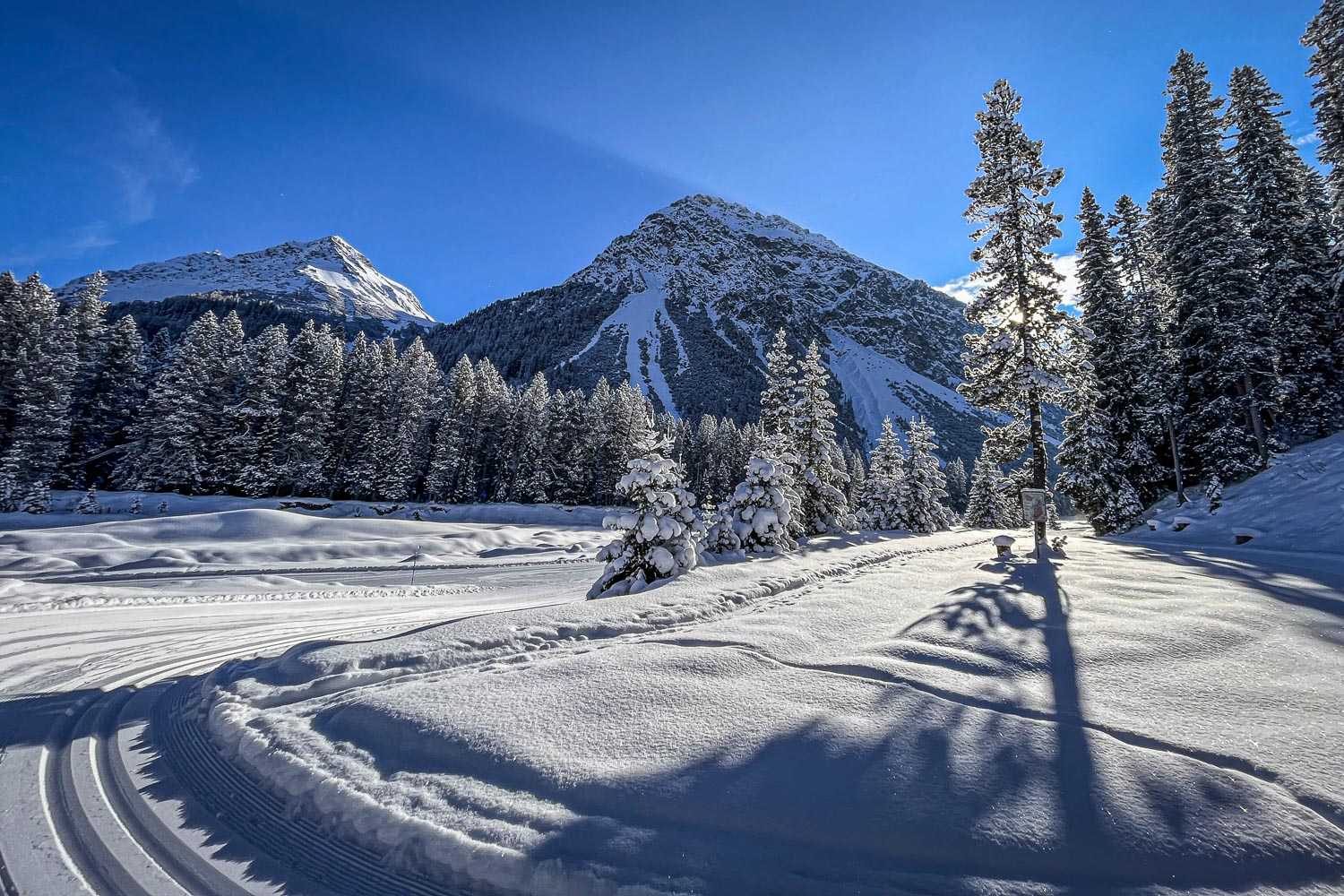
A paradise for cross-country skiing fans: the Arosa valley.
I set off under Florian’s watchful eye. Thanks to his precise and friendly instructions, I make better progress with every lap. I learn how to start, push off better, turn, use the poles at the right angle and utilise my physical strength more effectively. The only thing I don’t really want to do is skate, propelling myself solely with leg movements, similar to skating. Florian nods confidently: “Oh, it’s enough for the cross-country trail.” His confidence motivates me, because I can’t remember the last time I skied on a cross-country ski trail.
Everything is still in the shade
There is hardly any activity on the trail, only every few minutes someone comes towards us. The trail leads past the Isel reservoir, through open clearings and then into a dense forest with snow-covered treetops. The trail makes wide loops. Everything is still in the shade, the sun has not yet made it over the 2,605 metre high Schiesshorn and the slightly lower Amselegg.
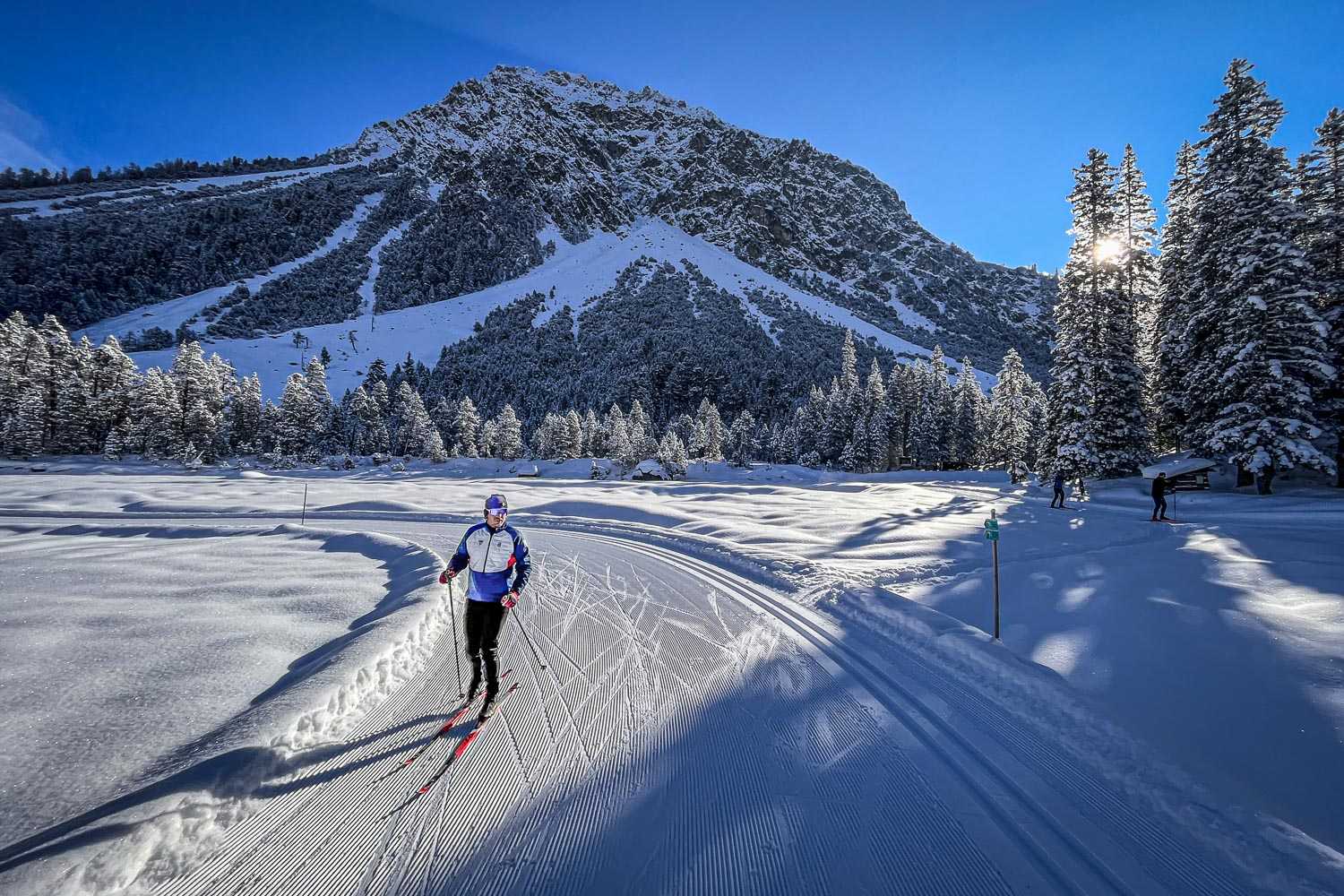
The Isel cross-country ski trail starts below the village of Arosa. The Isel is also known as Arosa’s ‘fridge’ and always offers the best snow conditions.
It is wondrously quiet. Florian skis silently behind me. Here in the dark forest between mountain pines, Swiss stone pines and spruces, apart from the cross-country ski trail, my eyes find hardly any traces of civilisation, hardly any anchor points or viewpoints, no signal colours. The body takes over, memorises every movement, goes on autopilot.
The earth rotates beneath me
The mind wanders freely through the green, blue and white tones of the natural panorama. Breath, pulse and the gentle crunching glide of the skis – they combine to form three instruments of a meditative soundtrack. The rhythm inspires the body, which drives forward; the basic sounds nestle around the mind, which dwells in the moment.
I feel like I’m treading water, the landscape is coming towards me, flowing through me. And then: the earth rotates beneath me, driven only by the power of the skis.
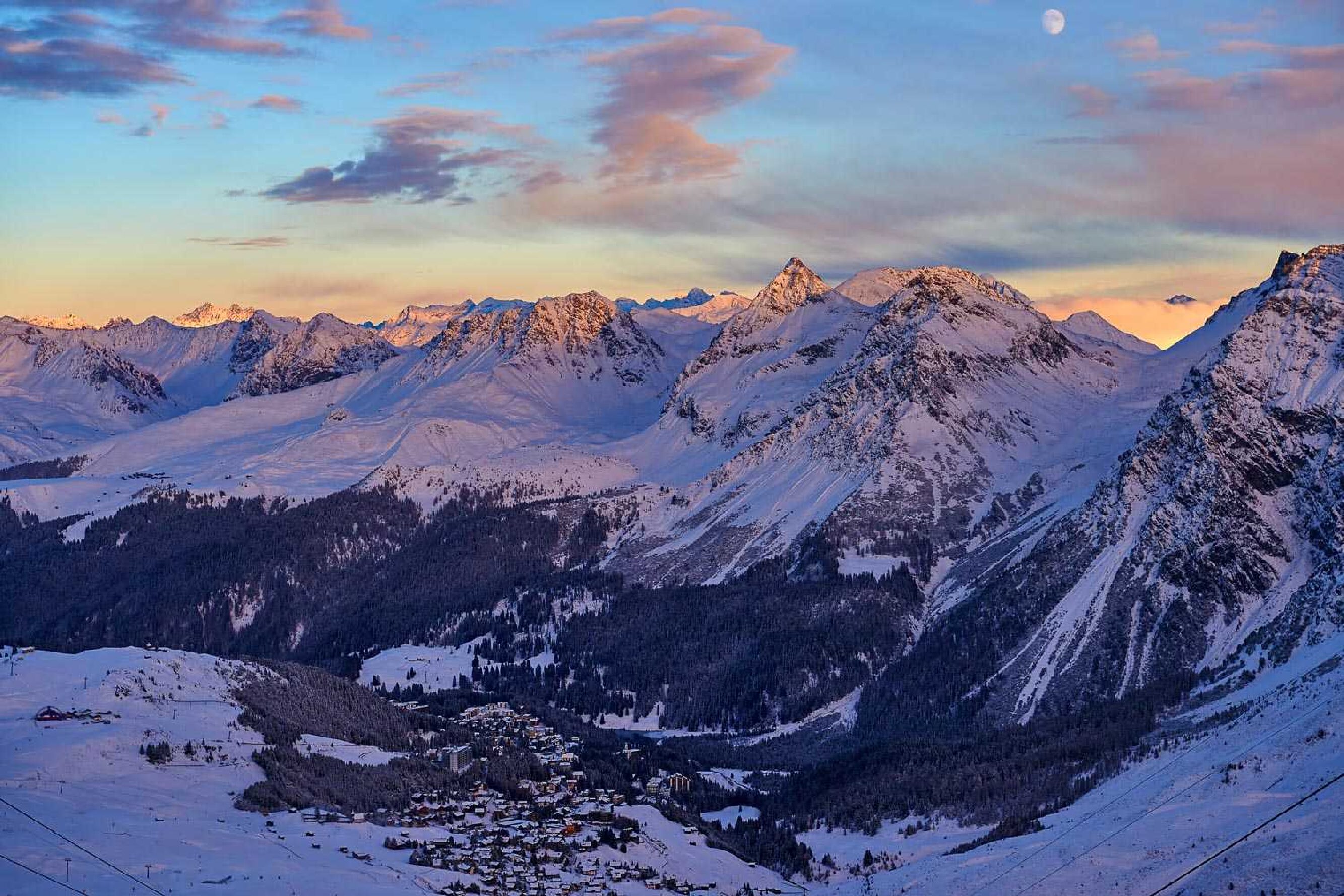
Evening atmosphere in Arosa with a view of the Hörnli (photo by Tourimus Arosa)
Backlight. Blinking eyes. The sun paints long tree shadows on the Welschtobelbach stream. We follow its frozen bed along an N-shaped cross-country trail loop. Shortly afterwards: What, already at our destination? Okay. I must have lost track of time. Have you forgotten me too?
Mind and soul in harmony with nature
Here in Arosa, I have become a cross-country skiing fan again. No other sport trains so many muscle groups at the same time, the cardiovascular system, coordination and balance – always easy on the joints, the soft snow absorbs every impact – and all this while enjoying the fresh air and nature. Cross-country skiing is easy to learn, for all ages and fitness levels, and offers the incomparable experience of merging body, mind and soul in harmony with nature.
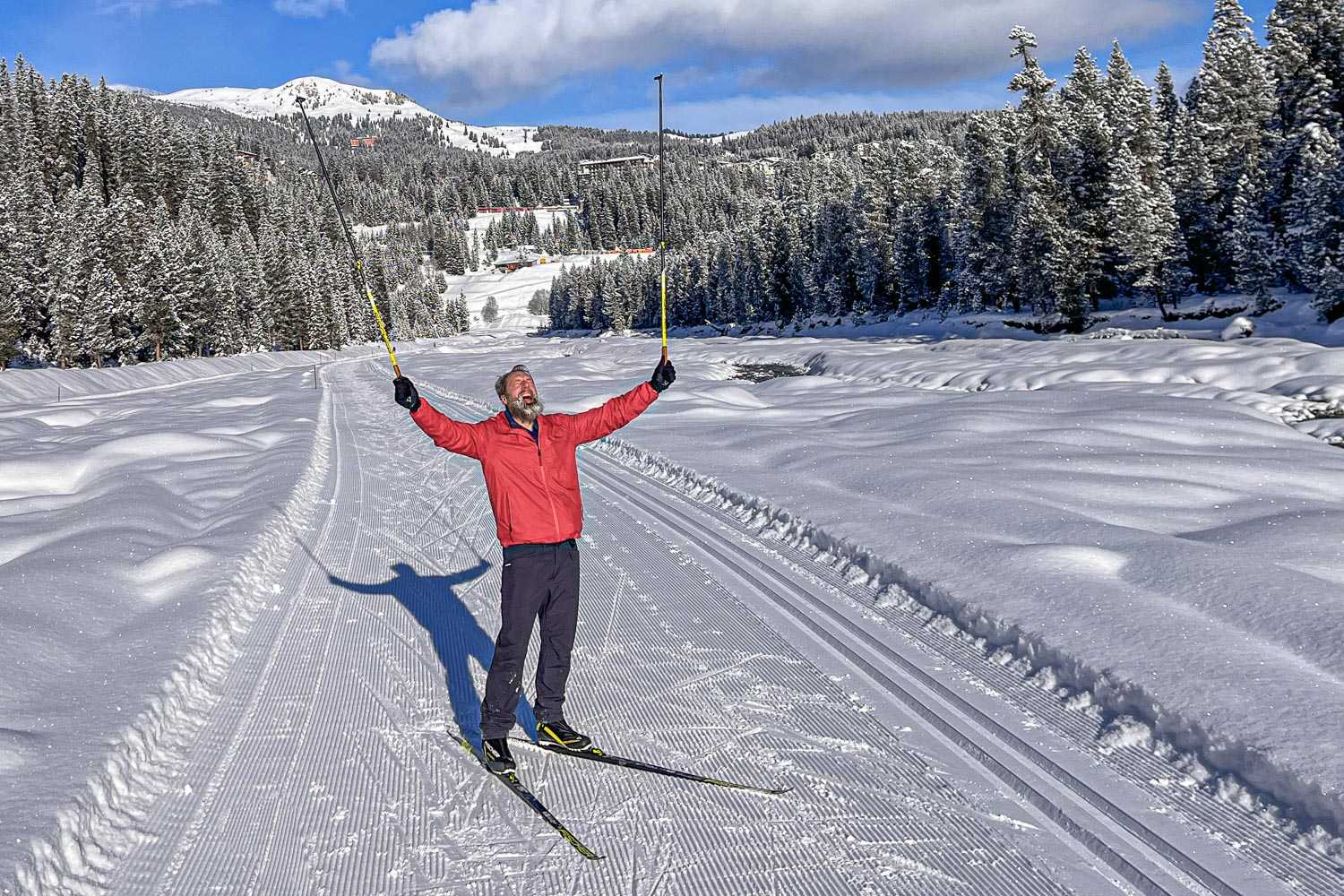
The Isel trail first leads past the southern shore of the reservoir of the same name and continues through the Schiesshorn forest, which is mainly home to Swiss stone pines. Pure, cool air flows into my lungs, glistening sunshine warms my skin and a wintery calm prevails. And I let my enthusiasm run free!
Ice swimming in Arosa – a test of courage with depth
Exhale deeply. Then my friend Markus Blum and I glide into the water. The cold is overwhelming – like a thousand needles piercing the skin at the same time. The impulse to escape is enormous.
The first minute is always the worst
David Knittel, founder and president of Eisbadi, Switzerland’s first public ice bathing centre, speaks in a calm voice: “Breathe in slowly, breathe out slowly. The cold is trying to panic your body. Concentrate. Stay calm. Breathe.”
The first minute is always the worst: after immersion, the body reacts in shock and releases massive amounts of stress hormones. It sends blood from the arms and legs to the heart and other vital organs to keep them warm. This takes a huge amount of energy.
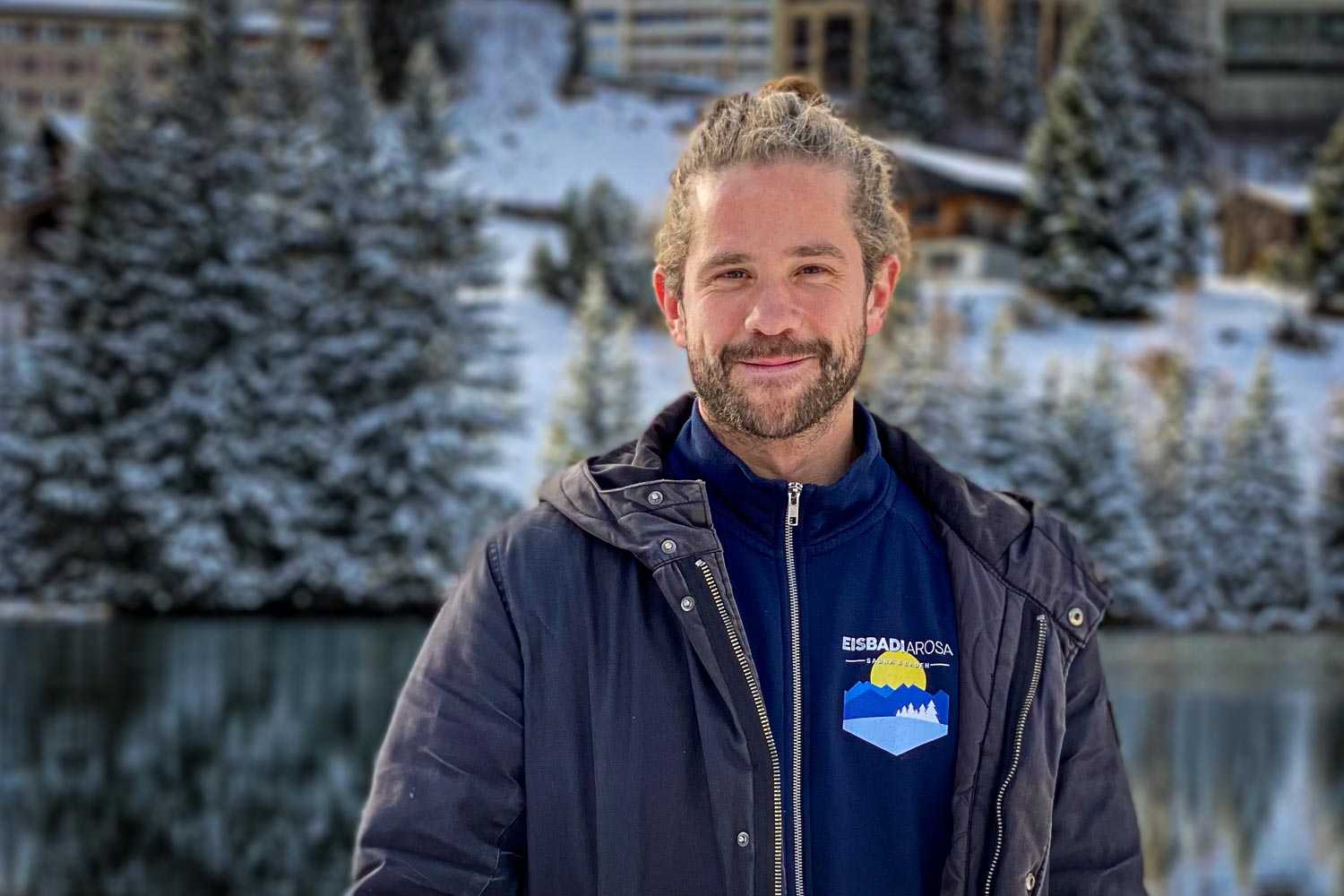
David Knittel, founder, ice bathing guide and president of the Eisbadi association (photo by Eisbadi Arosa).
Then it becomes more peaceful. The stress hormones fizzle out and a strange calm returns. Markus and I chat a little, which is distracting. “At home in Davos, I have a freezer in the garden. It runs for 24 to 36 hours, then I have ice for a fortnight – even in summer!” says the professional adventurer, Greenland traveller and daily ice-bather with a winning laugh.
Our skin is bright red from the cold
After seven minutes, we stagger out of the water, our limbs stiff from the lack of blood, our skin cancer-red from the cold, our minds as clear as the water behind us. While we warm up in the relaxation room – the sauna is occupied – David tells us about the origins of the Eisbadi: “It started in 2017 when two friends used to swim here every day in Untersee.” At some point, David joined them.
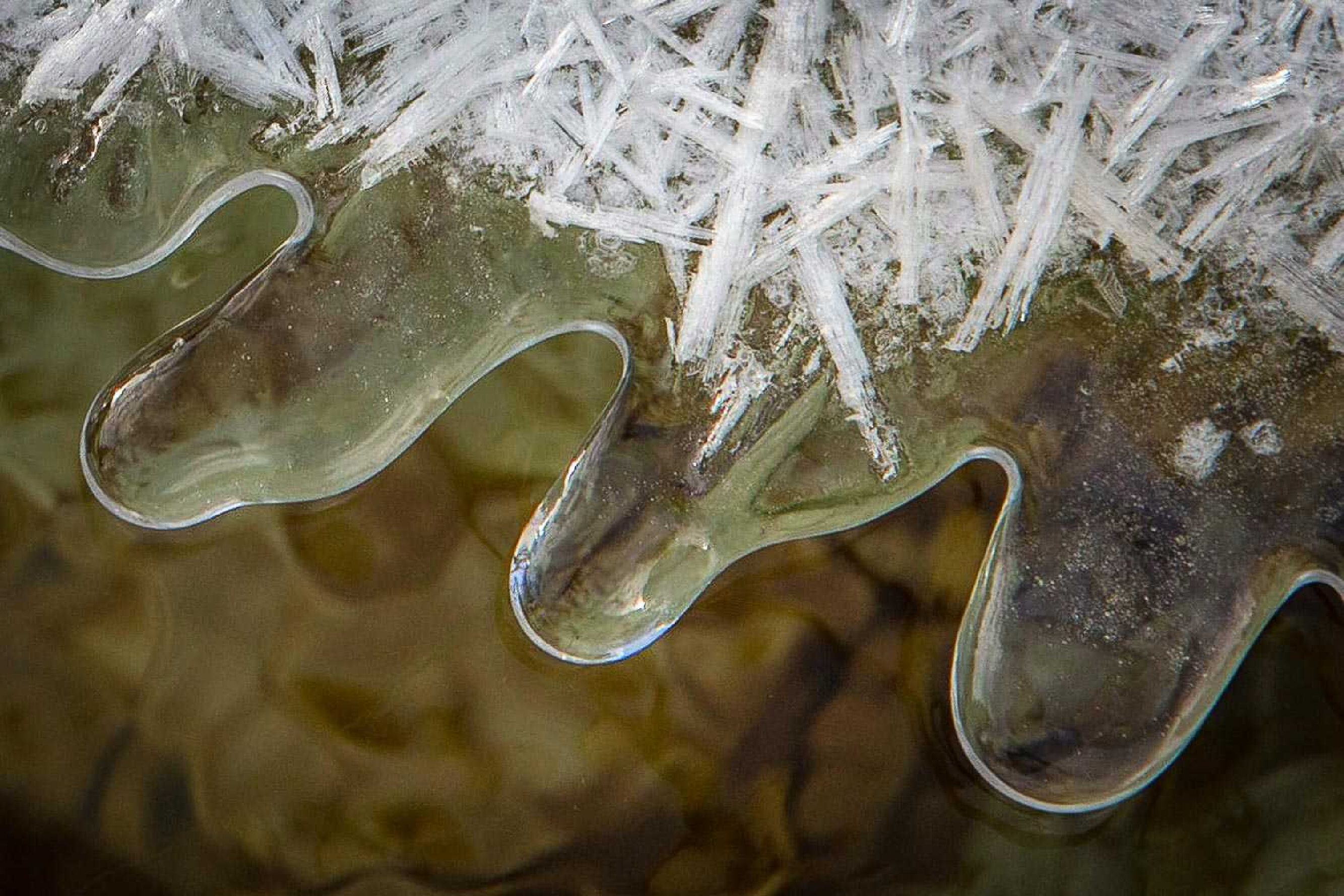
Ice artwork in a fountain in Pontresina.
“At first, I only lasted ten seconds in the water. And I screamed,” he admits with a laugh. David, a teacher by profession, only discovered his passion for ice swimming later, during a holiday in Bern.
The idea was born
Initially, an unofficial bathing area was created at Untersee. David took some time out, worked in catering and built the first sweat lodge together with friends – surrounded by two metres of snow. “People came to have a look. Soon after, we welcomed the first bathers,” he recalls. The idea was born: “We could do this officially!”
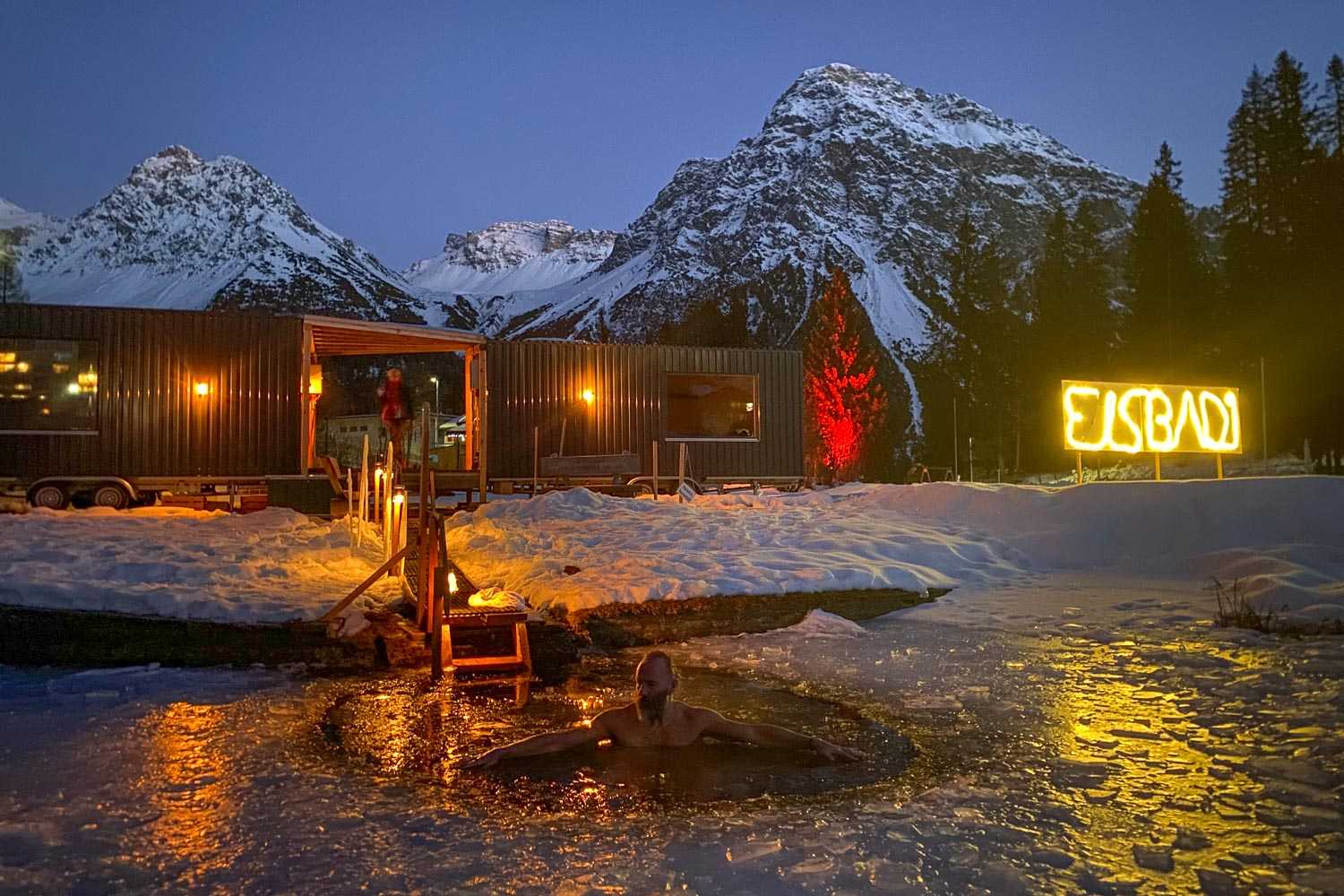
Ice bath at dusk (photo by Eisbadi Arosa)
A concept paper was created. After an unsuccessful slippery slope through bureaucracy and funding, the friends launched a crowdfunding campaign. 150 supporters donated a total of 40,000 Swiss francs, which mainly financed access routes and infrastructure. The first outdoor ice pool in Switzerland and Europe opened in 2022. Today, the municipality operates the Eisbadi.
On crisp winter days, the water freezes over again after just five minutes
On some days, up to one hundred people flock to Untersee in Arosa. For a donation of 3 to 5 euros, they can venture into the icy water between 6 am and 10 pm. On crisp winter days, the water freezes over again after just five minutes. Large ice floes then have to be removed from the pool every morning.
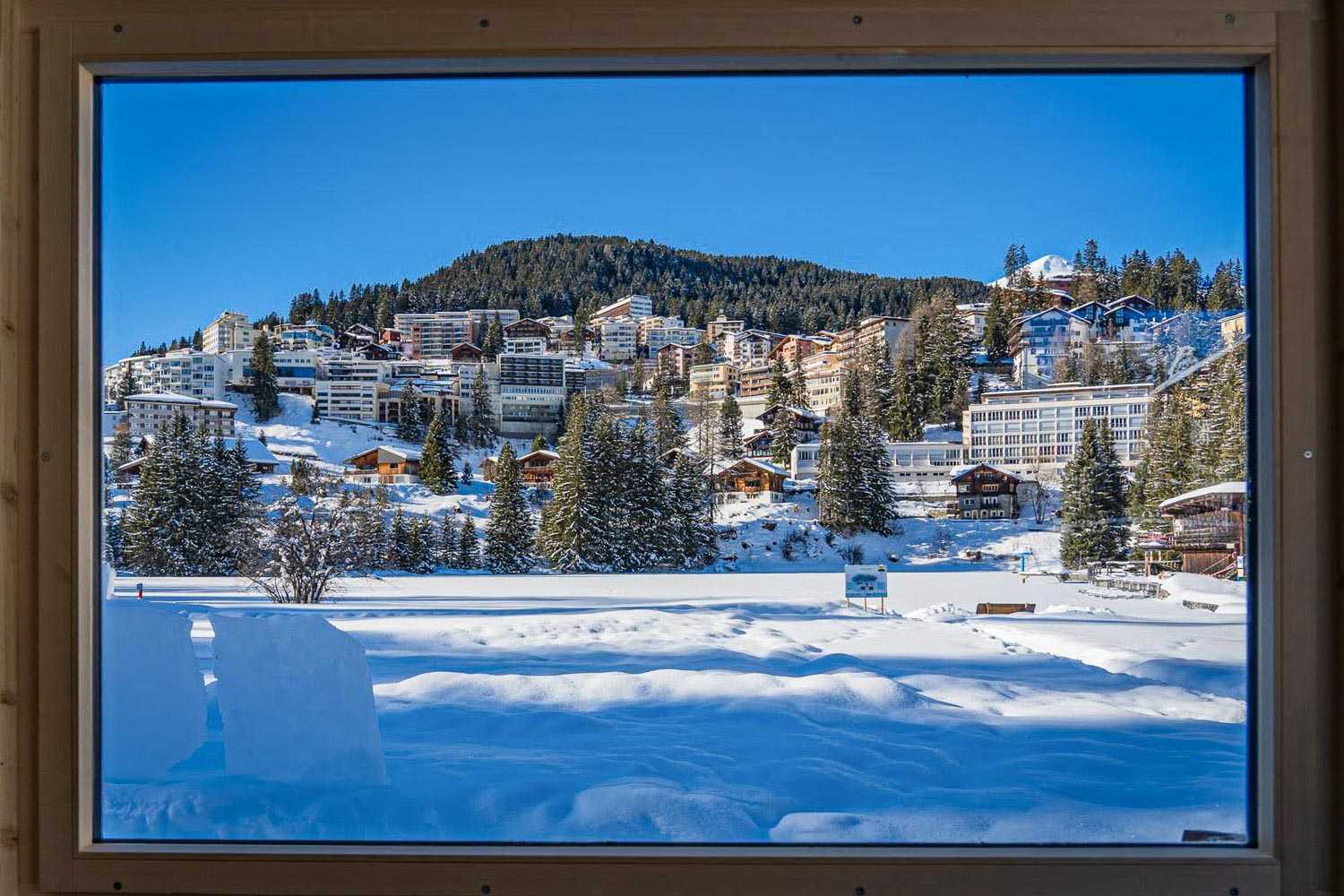
View of Untersee and Arosa from the sauna (photo by Eisbadi Arosa).
For all those who fancy an ice bath, the operators also offer “accompanied ice bathing”, where you are guided by professionals. Ice bathing in Arosa is more than just a test of courage. Many report positive effects: “Since I’ve been going into the ice water regularly, I no longer need painkillers for my rheumatism,” says one participant.
Caution is advised
But caution is advised. A phenomenon called afterdrop can occur when the body temperature drops to 35 degrees or below. “You start to shiver, even if you’re wrapped up thickly,” warns David. At a body temperature below 32 degrees, the shivering stops – a dangerous condition as the feeling of cold disappears.
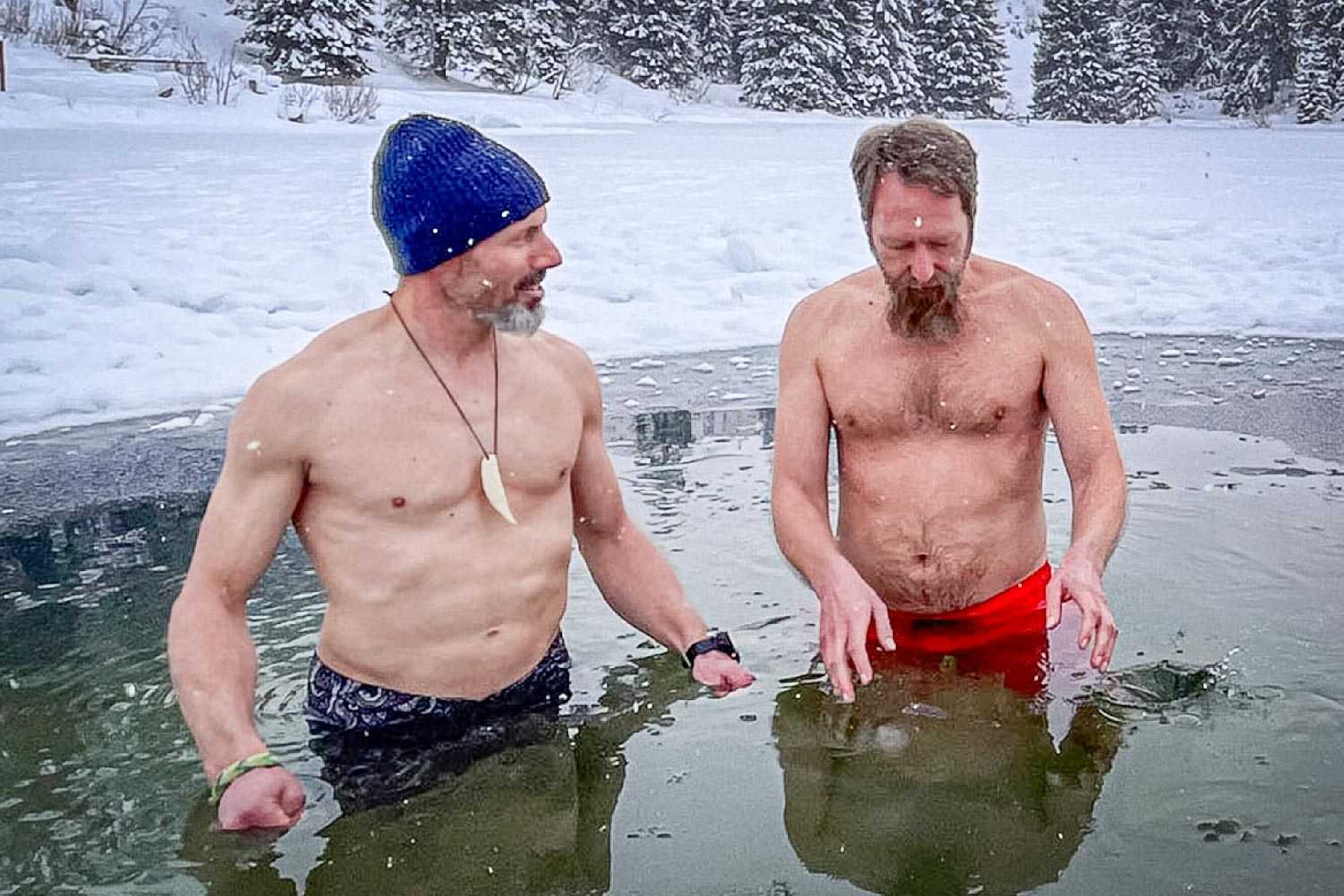
My adventure buddy Markus and I distract ourselves from the freezing cold by chatting.
He looks at Markus, then at me. “And longer than five minutes in the water is only good for the ego, I think,” he says with a wink.
“There are few things that bring you more into the moment than jumping into the ice,” says Markus. “It’s a source of focus, energy, inner strength – an inspiration for what’s inside us. And that is often much more than we realise.”
An experience you won’t forget for the rest of your life
I agree with Markus. With every breath, you train your body, mindset and will to persevere. For Markus, these are the foundations for the icy adventures to come. For everyone else, an ice bath can be a great source of strength. In any case, it’s an experience you won’t forget for the rest of your life.
The Eisbadi Arosa and Markus Blum invite all nature lovers to experience this unique experience for themselves. Further information at https://eisbadi.ch and https://www.adventurehealth.ch/de/winterangebot
Read now:
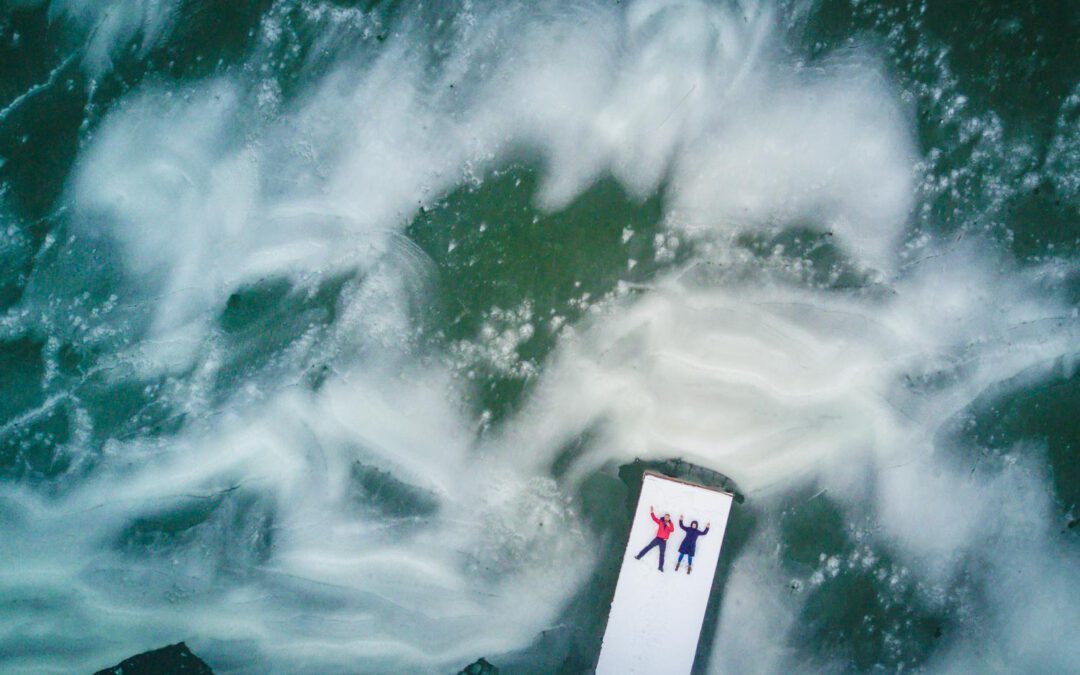
Ice climbing, ice breaking and ice diving in the Finnish winter
Finland: Breaking the ice
25 Min.From comfortable to extreme: snow-covered Finland offers some exceptional activities beyond the classic winter sports for those who like to experiment. Malte Clavin visited the only course in the world where you can learn to free dive under ice.
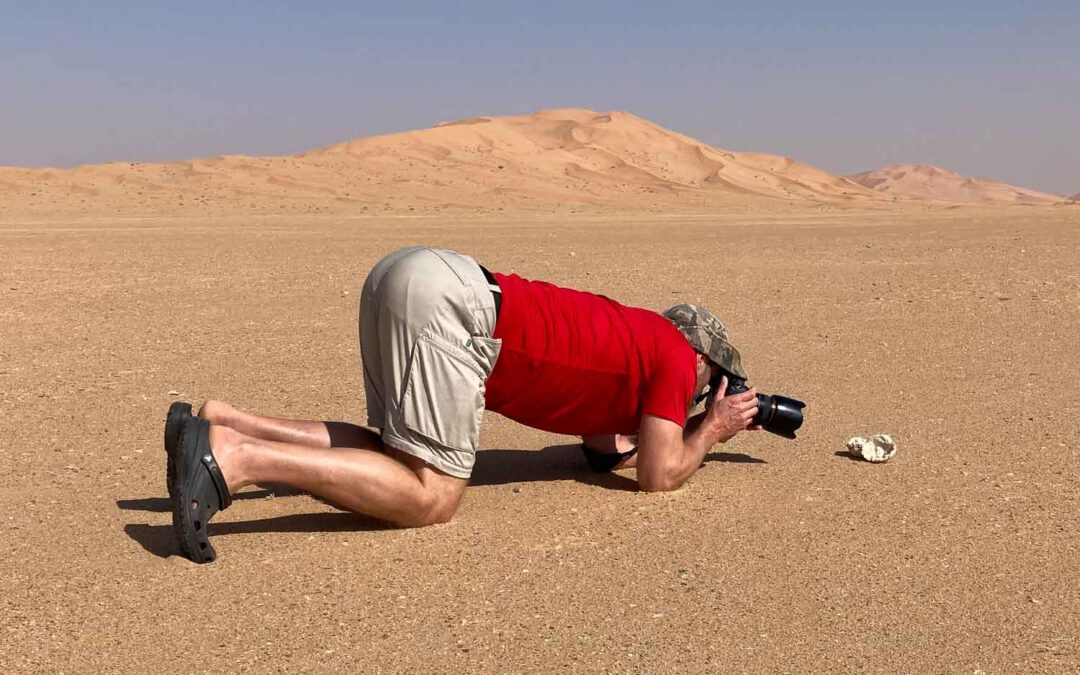
Caves, deserts & frankincense
Oman – in the sultanate of adventure
23 Min.Breathtaking desert landscapes, impressive mountain ranges, exuberant hospitality and delicious food. Oman offers all of that. I venture deep into the interior – the 7th Hole Cave on the Selmah Plateau is quite something.
"Freeze!"
Ice bath event with 12 participants
5 Min.Great conversations, lots of fun, breathtaking facts: That’s the conclusion of the private Wim Hof Method Breathing & Ice Bath session my wife and I hosted yesterday in our home and garden in Berlin – powered by Wim Hof trainer Daniel Ruppert. All of us 12 participants jumped into the icy waters.