


Published in:

Online portal of Germany’s largest news magazine
Text & Photography: Malte Clavin
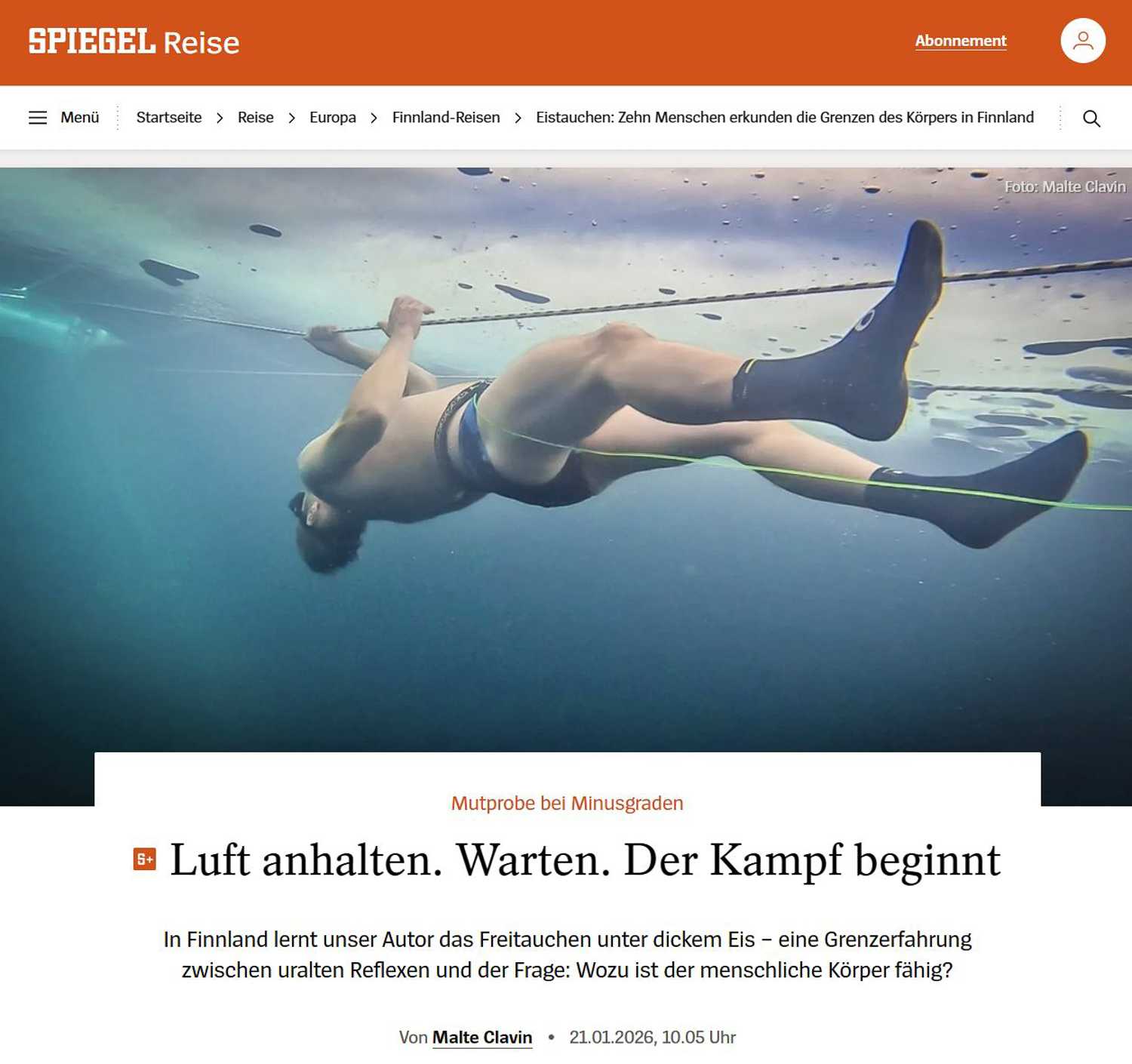
Link to the german article (paid article on spiegel.de)
My third dive lasts 47 seconds. The turquoise water around me clicks and bubbles. I dive with my eyes looking upwards, one metre below the ice cover of the frozen quarry lake near Taivassalo.
My head is now closest to the bottom
Small air bubbles wander around the ice above me as if looking for a way out. I stop, press the soles of my feet against the ice, stretch my body and look vertically into the depths, my head now closest to the bottom.
During the first two dives, I couldn’t cover the 20 metres from the entry hole to the exit hole fast enough, but now I take my time; there is enough air in my lungs.
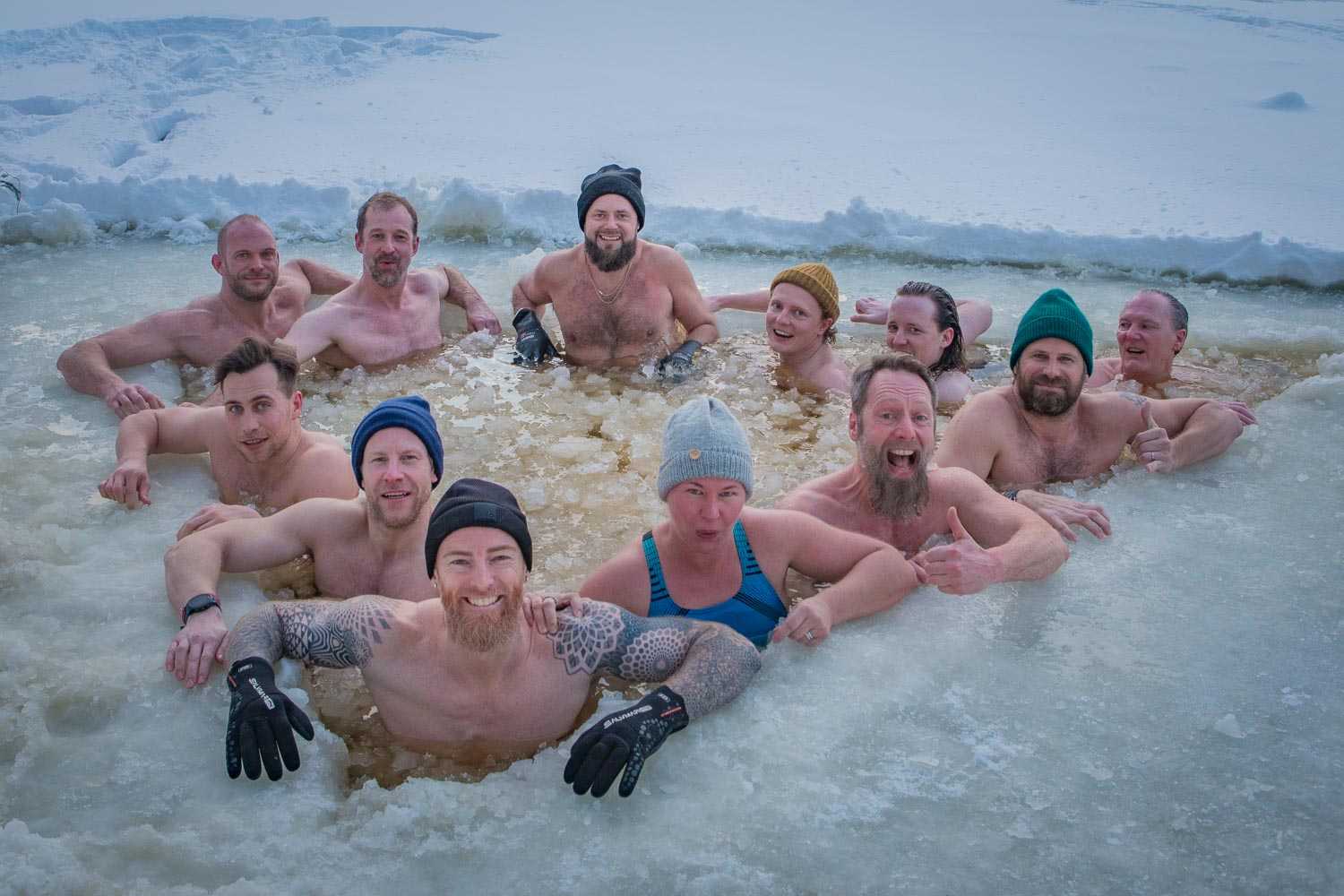
Group photo with course leader Leigh Ewin (front).
A few seconds later, which feels like an eternity, my hands clasp the white safety line again and pull me further. I step back onto the ice cover via a short exit ladder. Now I’m swaying as if I’m drunk.
“Your brain is lacking blood.”
“Brain freeze,” laughs Leigh Ewin. “Your brain is lacking blood. It’s still inside your body to keep your heart warm.” The Australian freediving instructor, in his early 40s, stands in a black winter coat at the edge of the ice hole, his assistant beside him. Two safety divers wait in the water, and nine other guests wait on the shore of the frozen lake, 50 metres away.
Diving under ice – in just swimming trunks. Why am I doing this to myself? Friends asked me this question weeks before I left.
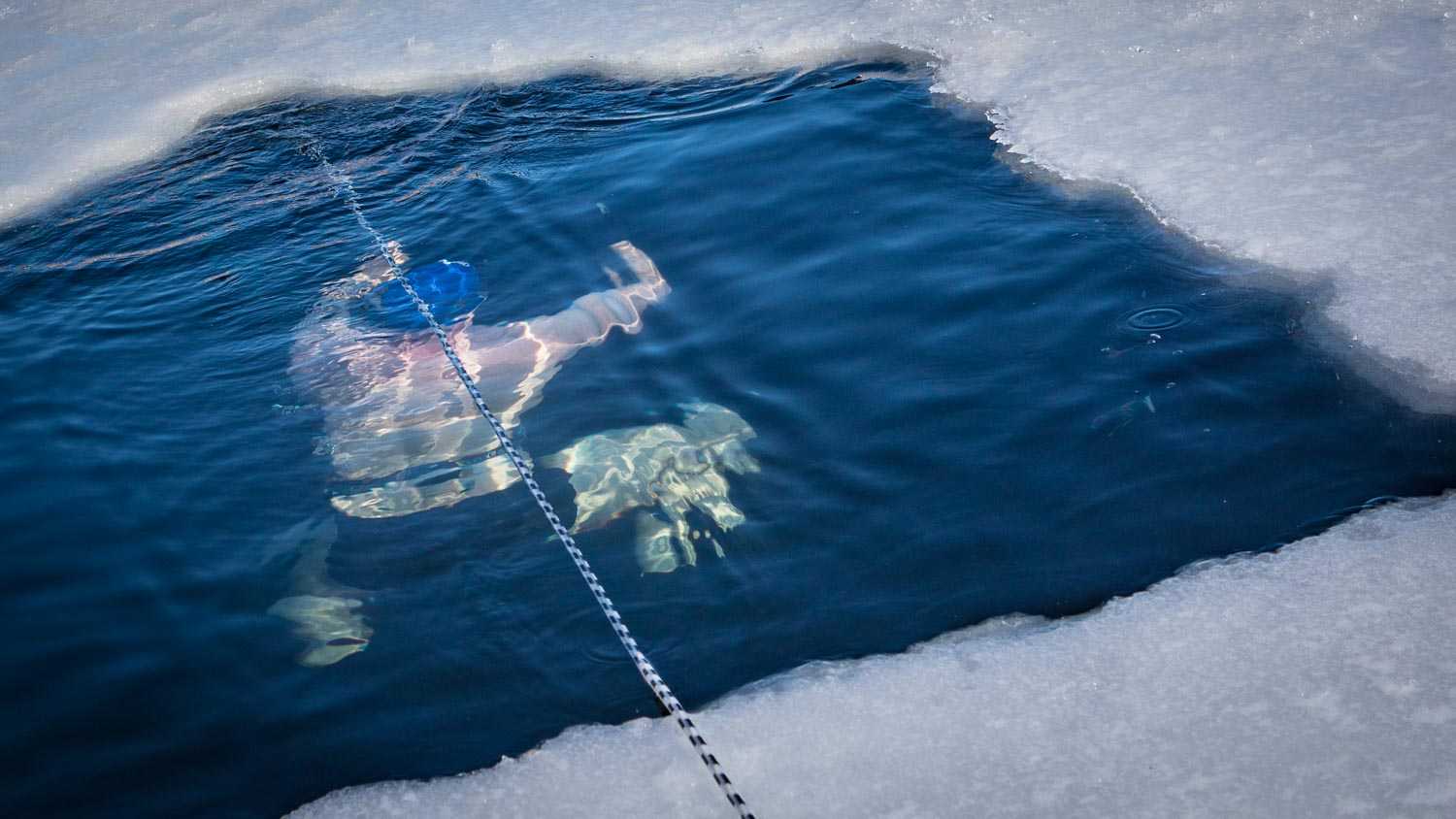
Three times the icy delight: Brain Freeze.
As a photographer, I look for images that no one will forget. As a human being, I am interested in where my limits lie. And as a journalist, I explore what happens when you cross those boundaries. To do this, I put general assumptions to the test, such as: “You’re going to kill yourself!” – something everyone who wanted to jump into the fresh snow in front of their house in their socks as a child will be familiar with. Is cold really so dangerous? Can’t you also gain something from it?
My explorer’s heart beats faster.
Studies have proven the positive effects of exposure to cold. Three minutes in an ice water bath can significantly reduce markers in the blood that indicate inflammation in the body over a period of five days, making the body less susceptible to it. That made me curious. I experimented with cold showers, breathing techniques and ice baths. Finally, I discovered a course that offers free diving under ice. It was said to be the only course of its kind in the world. My explorer’s heart beats faster. I signed up and travelled to Finland.
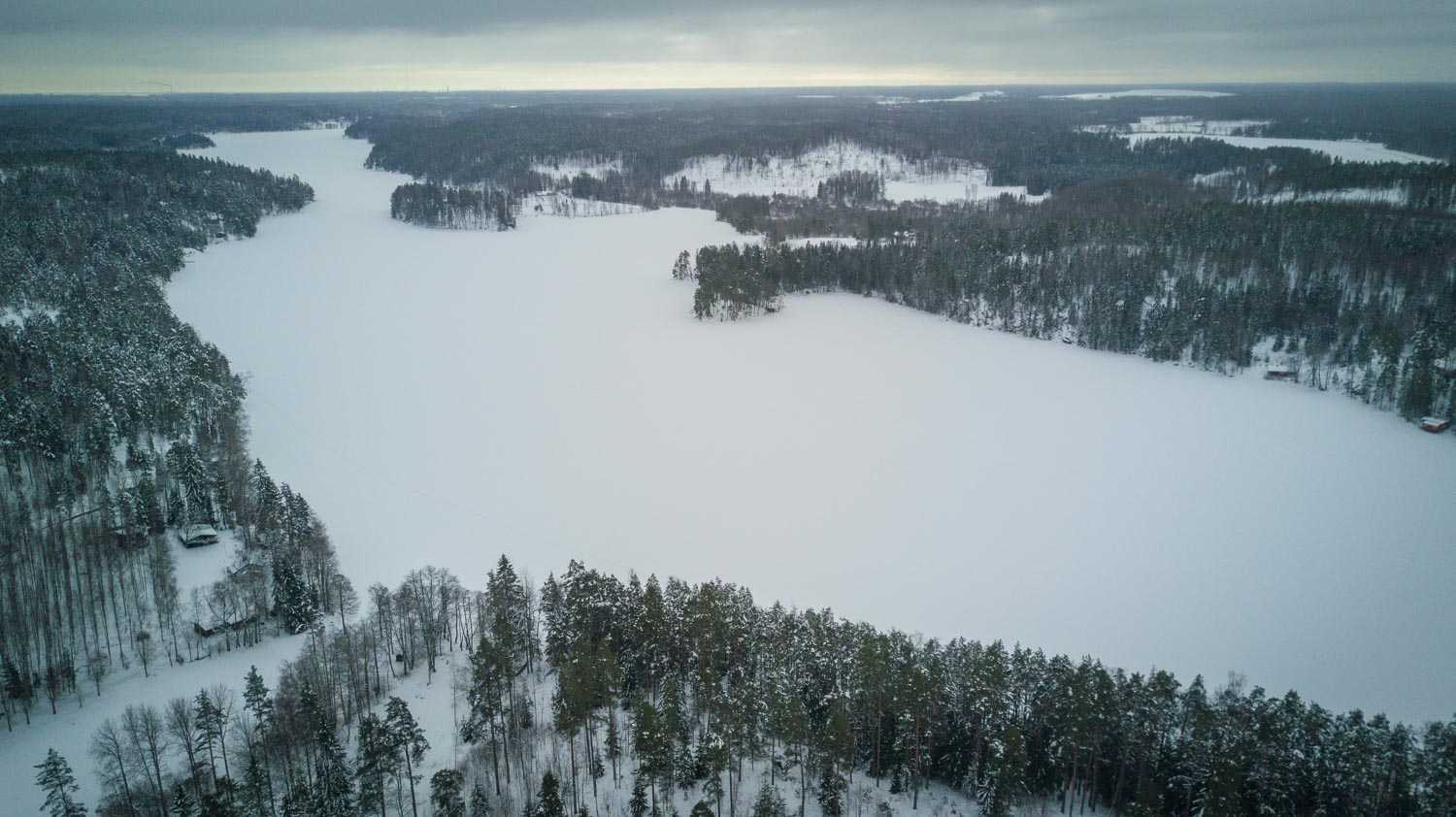
Aerial view of the lake near the seminar location.
Breathe in 30 times and hold your breath
Three days before the ice dive. Just under 50 kilometres from Helsinki lies the Lakeside Cottage Villa Paratiisi in Otalampi – our home for the duration of the course. Among the participants are a former professional boxer from Hamburg, an Israeli crypto investor, a German cold coach and a British banker with his two sons.
Wim Hof demonstrated in studies that taking cold showers and baths improves your health.
The next morning, Leigh introduces us to Wim Hof breathing, developed by Dutch “Ice Man” Wim Hof, who has proven the health benefits of cold showers and ice baths in studies.
The technique consists of several breathing cycles, each with about 30 breaths. Lying comfortably on the floor, you breathe in very deeply with your diaphragm and then relax your filled lungs – without actively forcing the air out. This enriches the blood with oxygen.
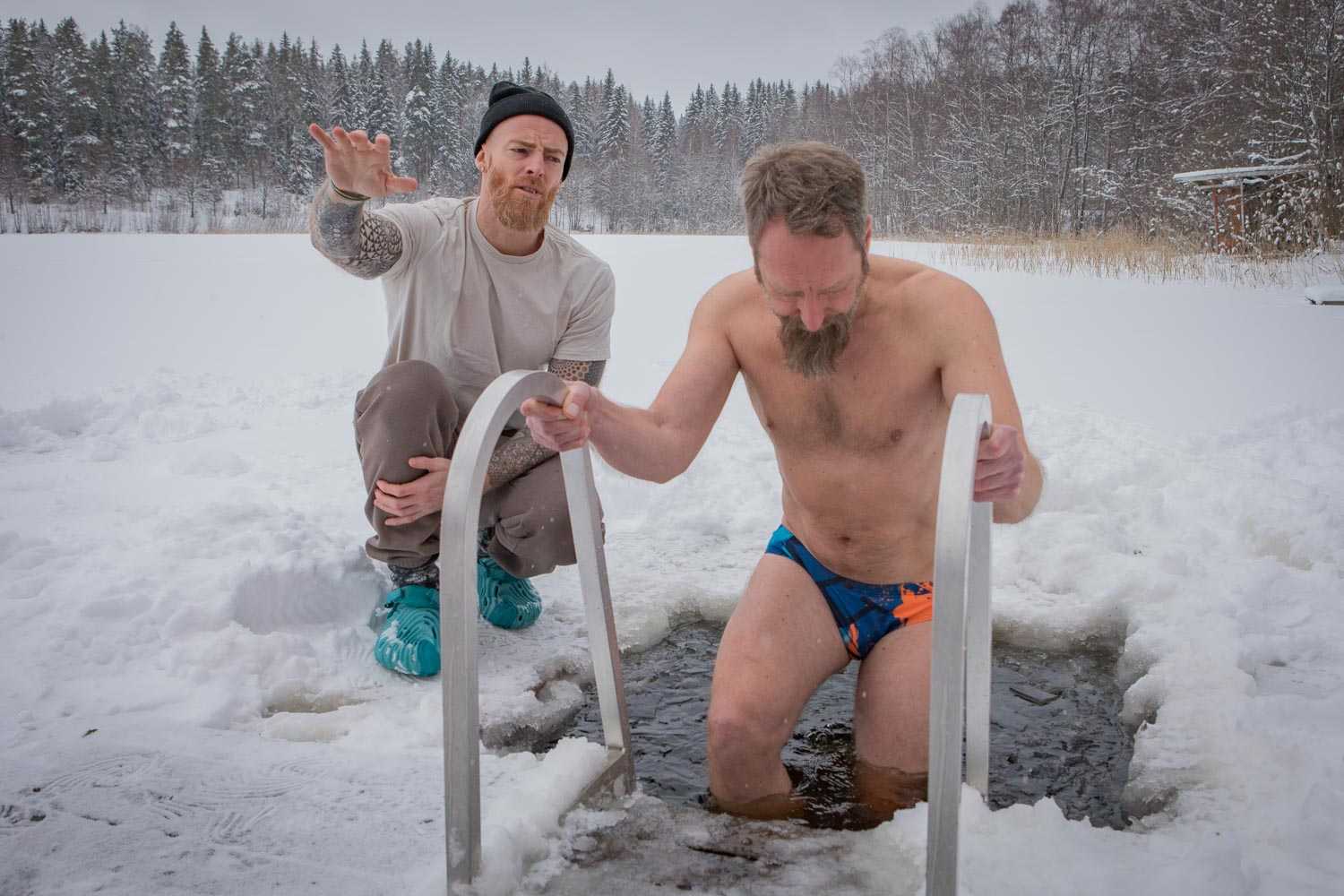
First short ice bath in the frozen lake. Many more will follow.
The 30th breath is as deep as possible. Then Leigh instructs: Hold your breath. Wait.
For the first minute, there is only silence. But then the urge to breathe kicks in, the diaphragm twitches. The struggle begins.
“Relax into the pain.“
Normally, I would gasp for air now, but Leigh’s voice guides us through the resistance. “Relax into the pain,” he says. It is a paradoxical experience: while my mind sounds the alarm, my body slips into a state of deep vibration. Behind my closed eyelids, purple veils of colour begin to pulsate. Time loses its linearity; I exist without breathing.
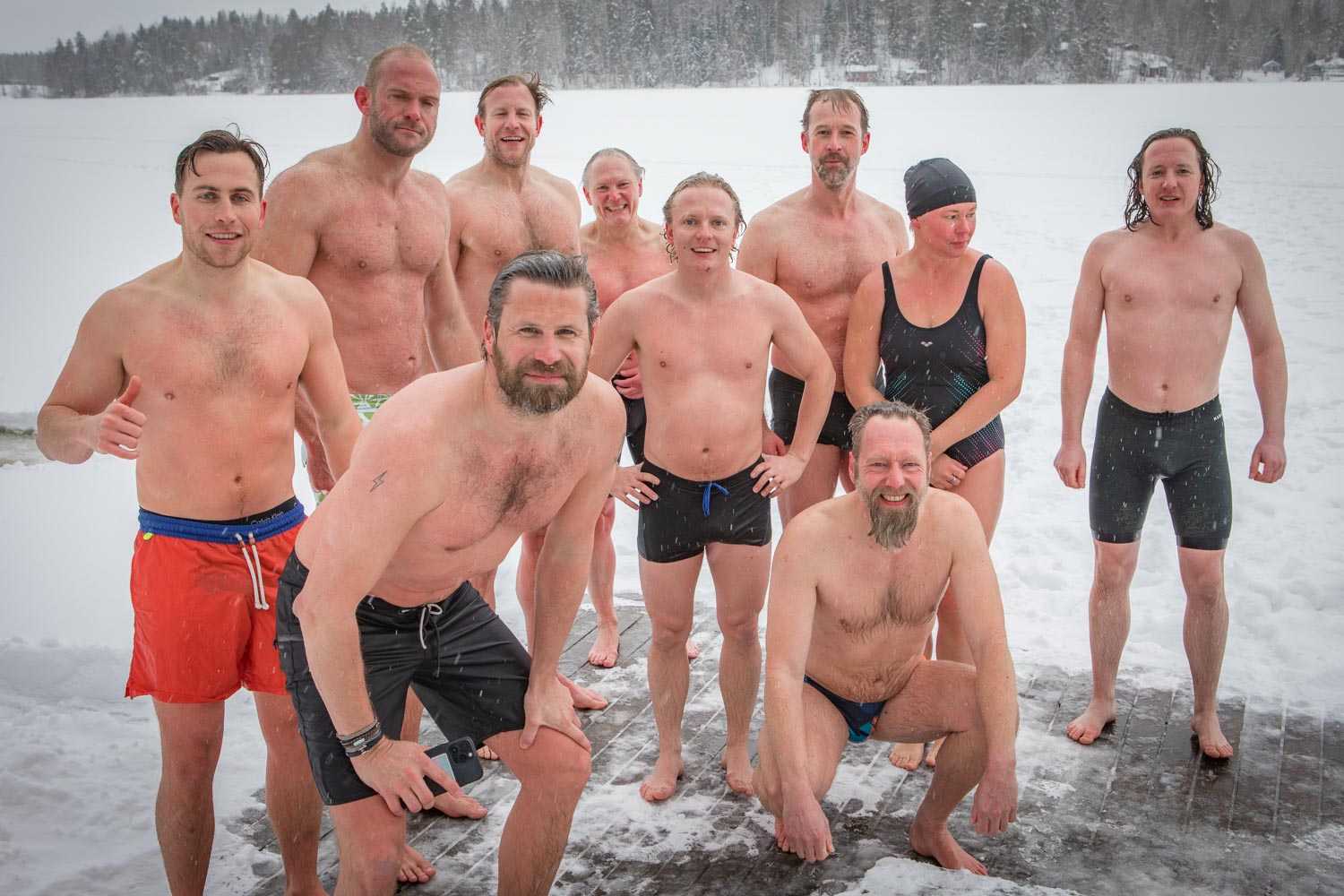
All participants after several ice test baths.
At some point, Leigh counts down from ten to zero. Inhale. Next cycle. “Shift up a gear,” Leigh instructs, “increase the tempo.” Another 30 breaths, only faster. But now it’s: “Empty your lungs. Exhale completely. Gently.” Wait again. Now I feel a slight dizziness. For others, it’s more extreme, as I later learn: tingling all over the body, hallucinatory patches of colour, time blurring.
Held my breath for three minutes. Unbelievable.
With each cycle, we increase the breathing rate, finally reaching maximum speed. And how long did we hold our breath in the end? Leigh reveals: three minutes. Unbelievable.
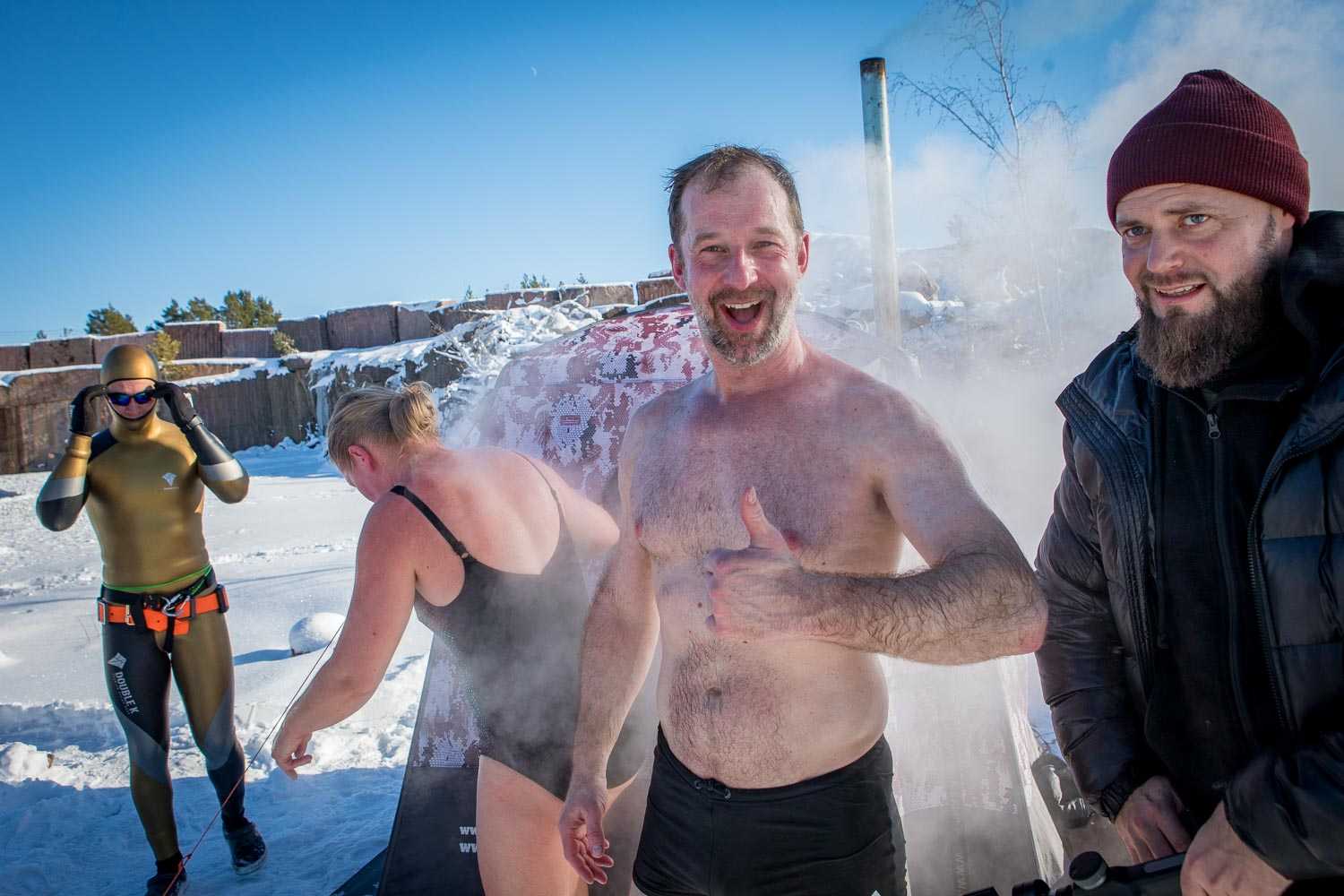
Daniel warmed up in the sauna tent before his second dive.
During a break, I strike up a conversation with Daniel Ruppert, the cold coach from Berlin. The former architect, in his early 50s, suffered burnout twice before “the ice” and breathing techniques brought him back to life. “Our bodies are made for cold,” explains Daniel. “Thousands of generations before us shivered in icy winters, crossed bodies of water, starved for months. Countless metabolic winters have made our bodies resilient . Today, we hardly use that anymore.”
The comfort zone is the new danger zone
The comfort zone, says Daniel, is the new danger zone. Many modern diseases can be traced back to physical underchallenge and excessive nutrition. “A three-minute ice bath won’t kill anyone,” says Daniel. “It increases the release of serotonin, melatonin, testosterone and dopamine – in some people by up to 300 per cent. All of this has been proven in studies.”
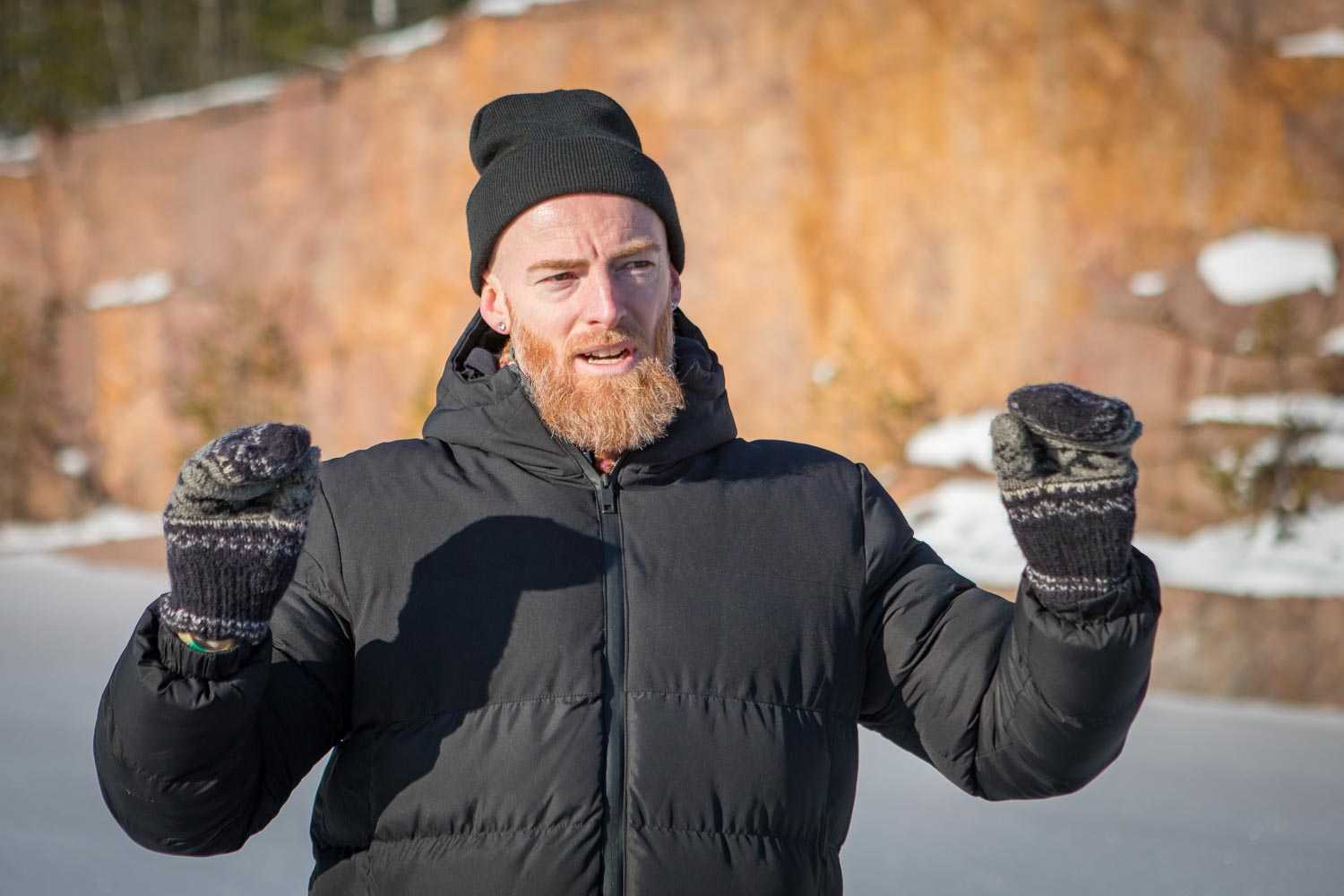
Leigh Ewin gives final instructions before the ice dive.
Leigh joins us. Experts among themselves. Now a technical dialogue unfolds about vasodilation, brown adipose tissue, neuropeptide Y, theta brain waves – I can’t keep up anymore.
“After a few moments, I fled screaming.”
I ask Leigh how he, an Australian, came to take this ice course. “I came to Finland for love and first worked as an intern in Espoo. My colleagues lured me into an ice bath with their mobile phones at the ready. After a few moments, I fled screaming. My colleagues laughed, shared the videos and commented: Look, our intern. He loves the cold!”
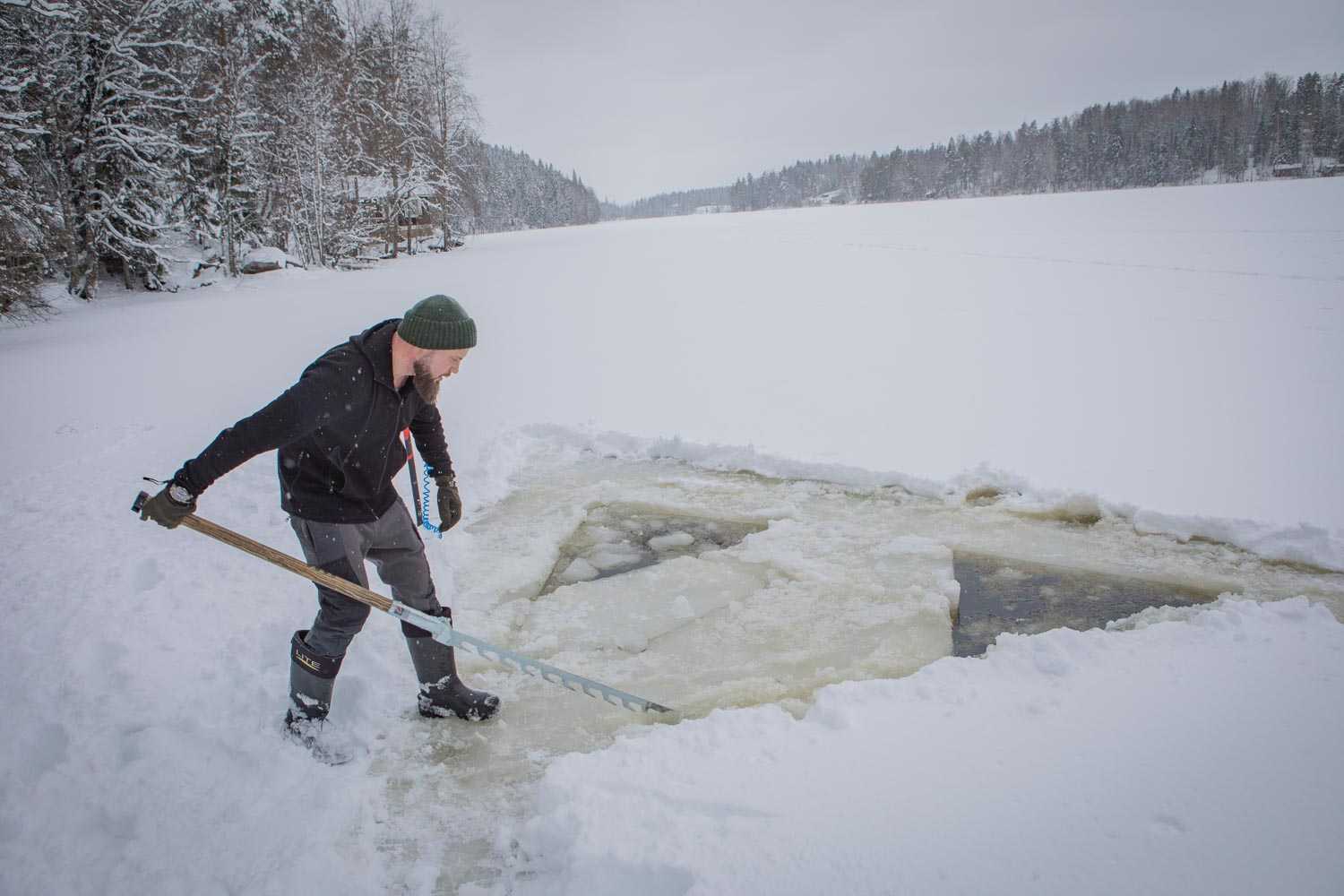
Oki saws a triangular pool free. It freezes over again in just one hour.
The humiliation repeated itself the following winter. Leigh vowed never to experience it again. He experimented with meditation, biohacking and breathing techniques. “At some point, I was able to stay in the ice longer than my colleagues. Then there was only one person left laughing.” Encouraged by his success, Leigh began to delve deeper into the subject.
That was the birth of free diving under ice.
He was taught various breathing techniques, learned free diving and became a certified Wim Hof instructor. “One day, I was someone who led others into the ice. More importantly, I was able to free people from something that had blocked them their whole lives: fear. It was like breaking a chain.” He began to combine his passions. That was the birth of free diving under ice.
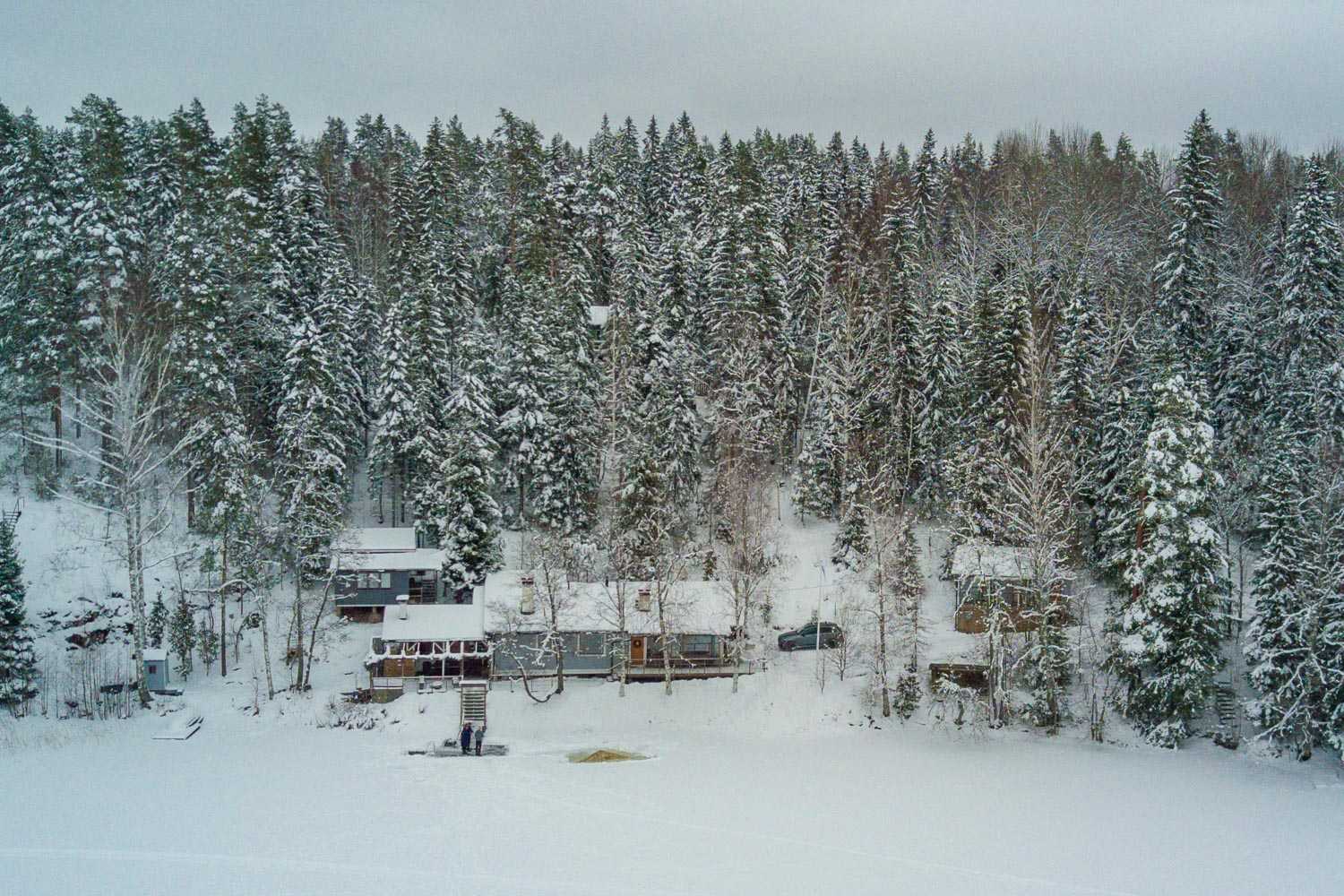
The seminar location about two hours’ drive from Espoo. The two ice baths can be seen in the foreground.
One metre below the ice
Outside, the temperature is just below zero degrees Celsius. Wearing only our swimsuits, we walk in single file to a small hole in the frozen lake, 20 metres from the hut.
An assault on the nervous system
Under Leigh’s close observation and guidance, each of us slides into the water one by one.
The first moment is a shock, an assault on the nervous system. When the black water reaches my chest, my skin burns like fire – a paradoxical reaction of the nerve endings to the extreme cold. My breath wants to stop, a gasp escape, but I force myself to stay calm. Exhale. Slowly. Only after 30 seconds does the stinging pain give way to a strange, tingling numbness.
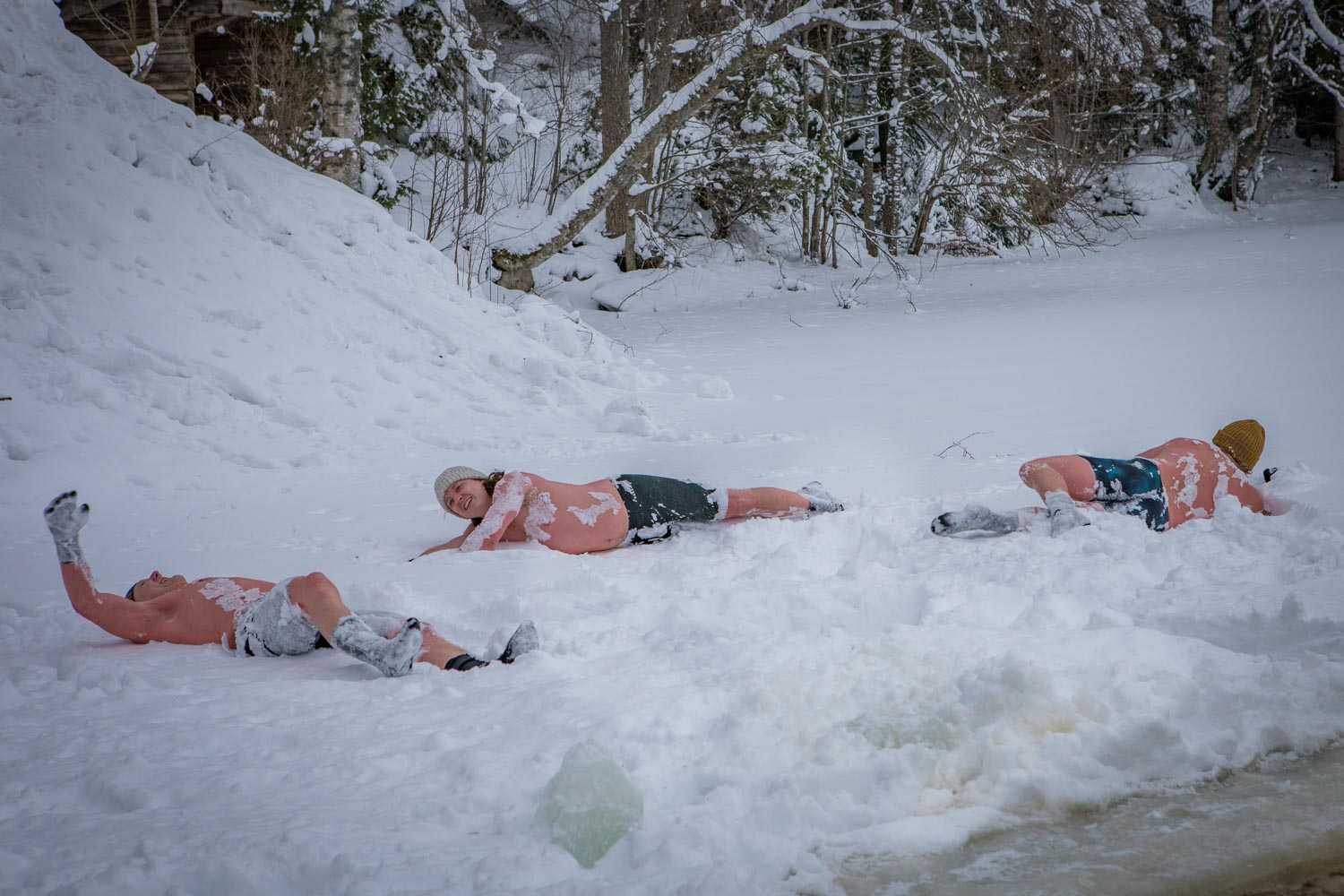
After the ice bath, we go one better: Rolling around in the snow.
During the first immersion, my head remains above water. This is followed by warming up in the sauna.
Immediately afterwards, the second ice bath begins, this time with diving goggles and a few seconds underwater.
The body should be accustomed to cold water through repeated immersion.
During the third bath, a snorkel is put on to extend the diving time. The exercise serves to habituate, to accustom. The aim is to accustom the body to cold water through repeated immersion, to convey to the body that there is no danger and to mitigate any escape reflexes. These could be devastating under the ice due to the lack of escape options.
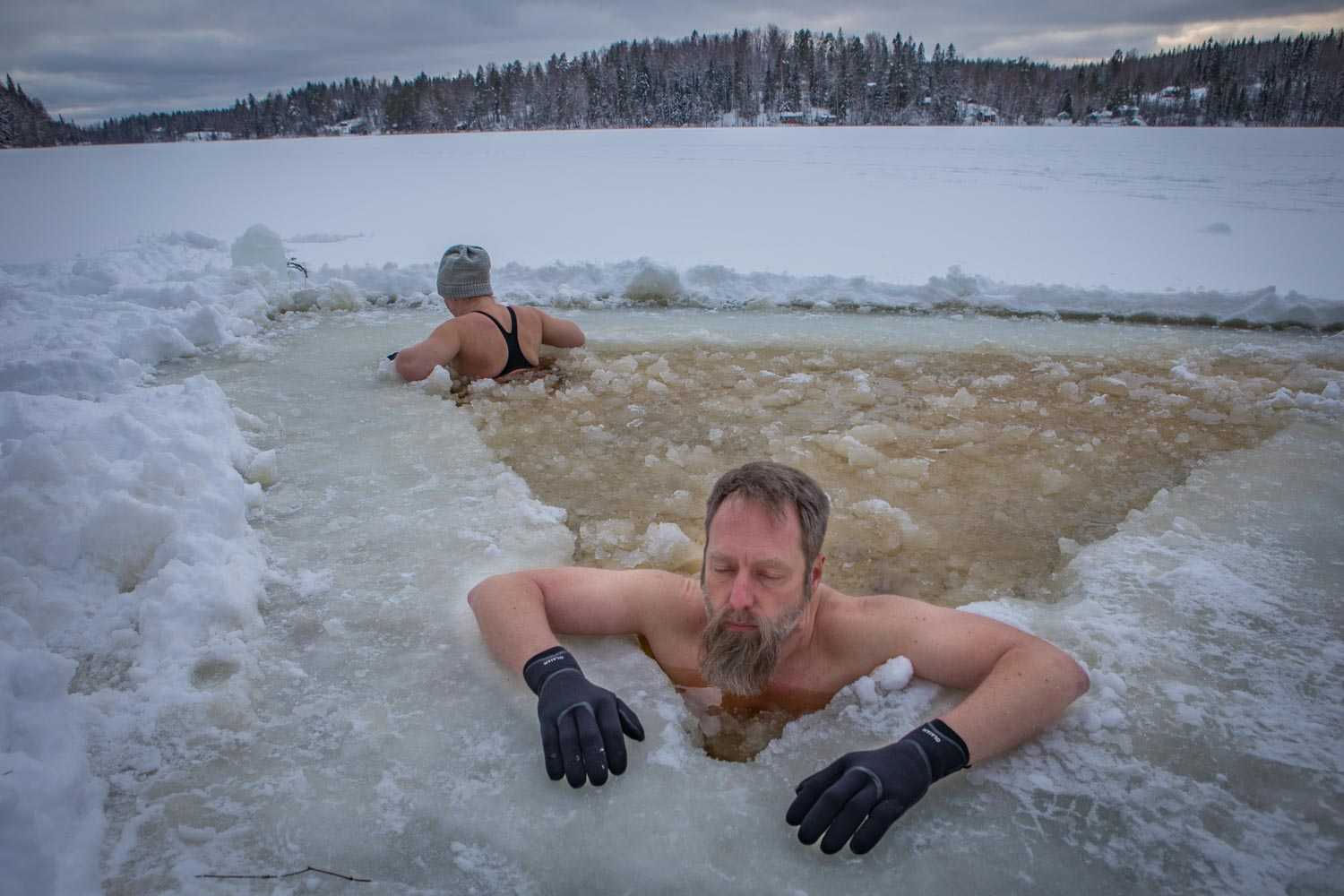
Seven minutes of humming in an ice bath. This stimulates the vagus nerve, which in turn slows down the heartbeat.
In the afternoon, the three of us climb into a larger triangular pool that his assistant has previously sawed out of the ice lake. Humming, we remain in the ice for seven minutes, each in a corner. The humming stimulates the vagus nerve, which enhances communication between the brain, stomach and heart and slows the heartbeat – making it possible to stay in the ice for longer.
A man in an extravagant, golden full-body dry suit
Early in the morning on the third day, the final day of diving, we leave Villa Paratiisi and drive about 2.5 hours to a frozen quarry lake near Taivassalo.
There, we are greeted by a man in an extravagant, golden full-body dry suit. His name is emblazoned in large letters on his back: Miro Suonperä. He is the Finnish record holder in distance diving with over 200 metres and one of the two safety divers. The other is his father. Thanks to them, we feel safer.
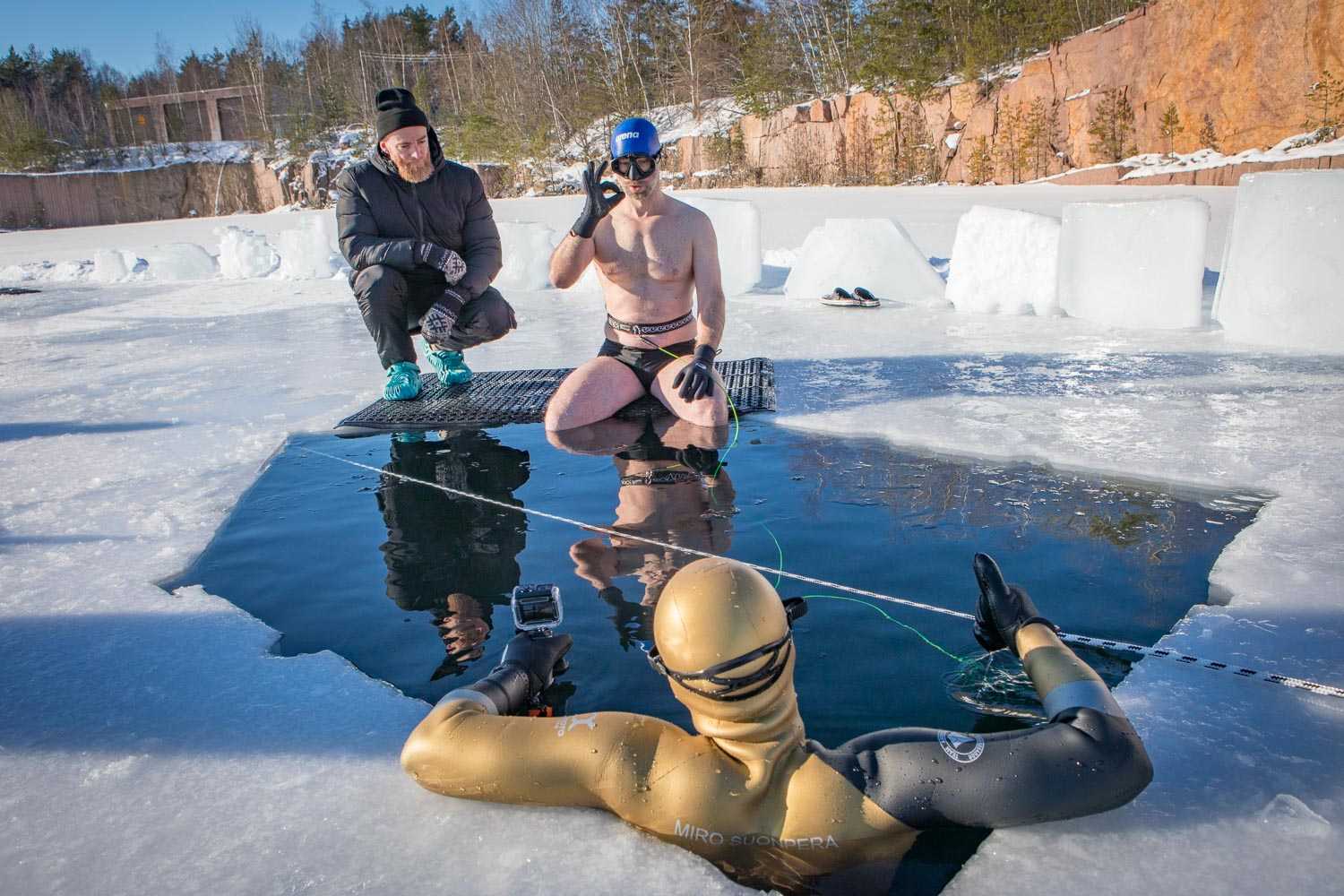
Daniel is ready to dive in and signals the OK sign to safety diver Miro.
On the shore of the lake, a tiny sauna tent for a maximum of three people steams away, serving as a place to warm up after the ice dives. We take off our winter clothes except for our swimming trunks.
Miro and Leigh give a thumbs up. Here we go.
Those who wish to do so can put on a swimming cap, gloves or diving socks to protect the parts of the body most sensitive to the cold.
It’s my turn. Leigh waves me over and puts a safety belt on me. It is connected to a rope that runs from the entry hole to the exit hole. This way, I can’t get lost. Miro and Leigh give me the thumbs up. Here we go.
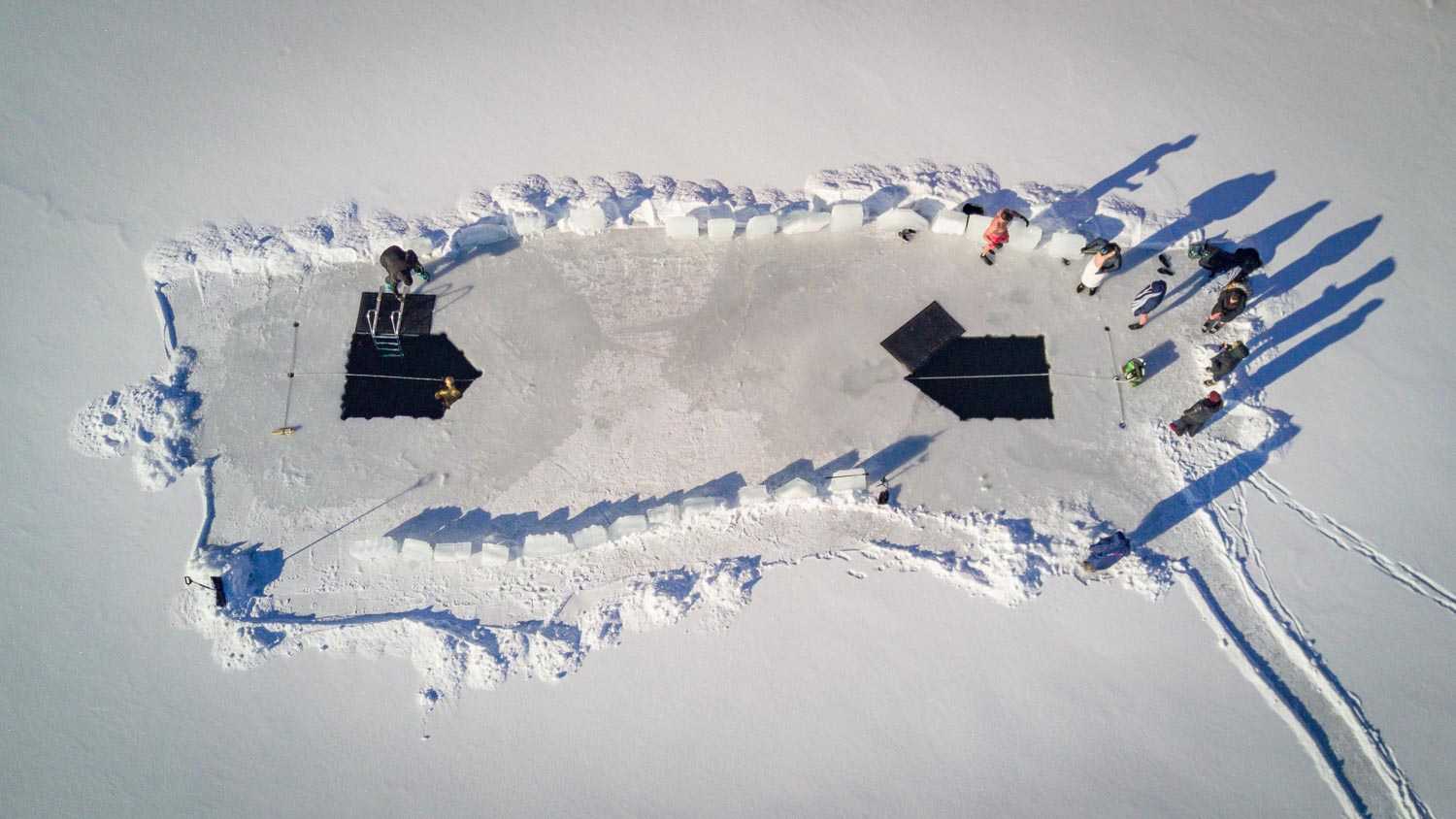
Aerial view of the entry and exit points.
I dive in, grab the white safety line and quickly pull myself along about a metre below the ice cover. After 17 seconds, my head emerges from the water. I couldn’t really enjoy it.
A few metres before the exit, I take a break.
On the second dive, I take it slower. A few metres before the exit, I take a break. My legs have strong buoyancy. I press my soles against the ice and look into this strange world. The light refracts in the water, small air bubbles rise.
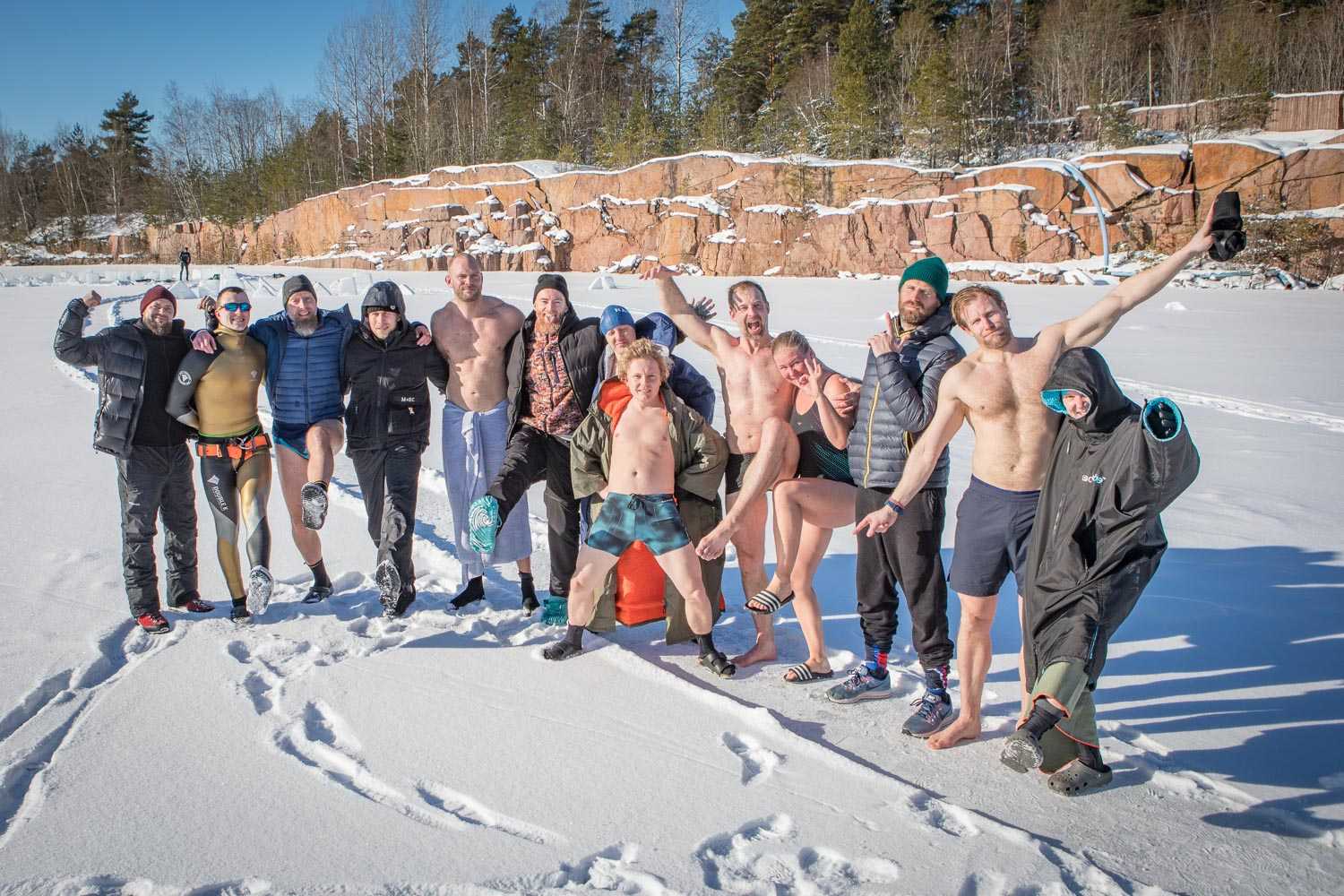
Farewell group photo after each of the ten participants completed at least two free dives under the ice.
I have barely emerged from the water when Leigh motivates me to dive a third time . I do so, and less than two minutes later I leave the ice. I stagger like a drunk: brain freeze. Fortunately, the spell is over after a few seconds. The dive, however, is something no one will forget in a hurry. It couldn’t be any colder. Nor any better. Off to the sauna tent.
My limits are much further than I ever believed.
Physically, I have learned to endure the cold. But my real gain lies elsewhere: if you can control your body’s panic in ice water, if you can hold your breath for three minutes, you can take great calm back with you into your hectic everyday life. The ice has taught me that my limits are not where my fear projects images of horror, nor where pain begins. They are much further than I ever believed.
Read now:
Antarctica expedition
Singing icebergs, talented orcas, infinite silence
2 Min.Anyone who wants to go to Antarctica has to pass through the Drake Passage: six-meter waves, wind gusts of up to 120 km/h. Those who persevere are rewarded with bright blue icebergs, a world record holder of the skies, and endless silence. An expedition to the end of the world.
Pure inspiration
My new media kit 2025
< 1 Min.In this brand new 28-page media kit, I show you my work as an adventure journalist and speaker: Expeditions, travels, challenges – everything that excites me. Let yourself be inspired.
Rugged beauty in the Atlantic
Faroe Islands photo gallery
< 1 Min.Who would have thought that my beard, of all things, would get me in front of the camera? I am invited to the Faroe Islands in the North Atlantic to shoot an public relations film for an eco-energy provider. On board, of course, my camera.